

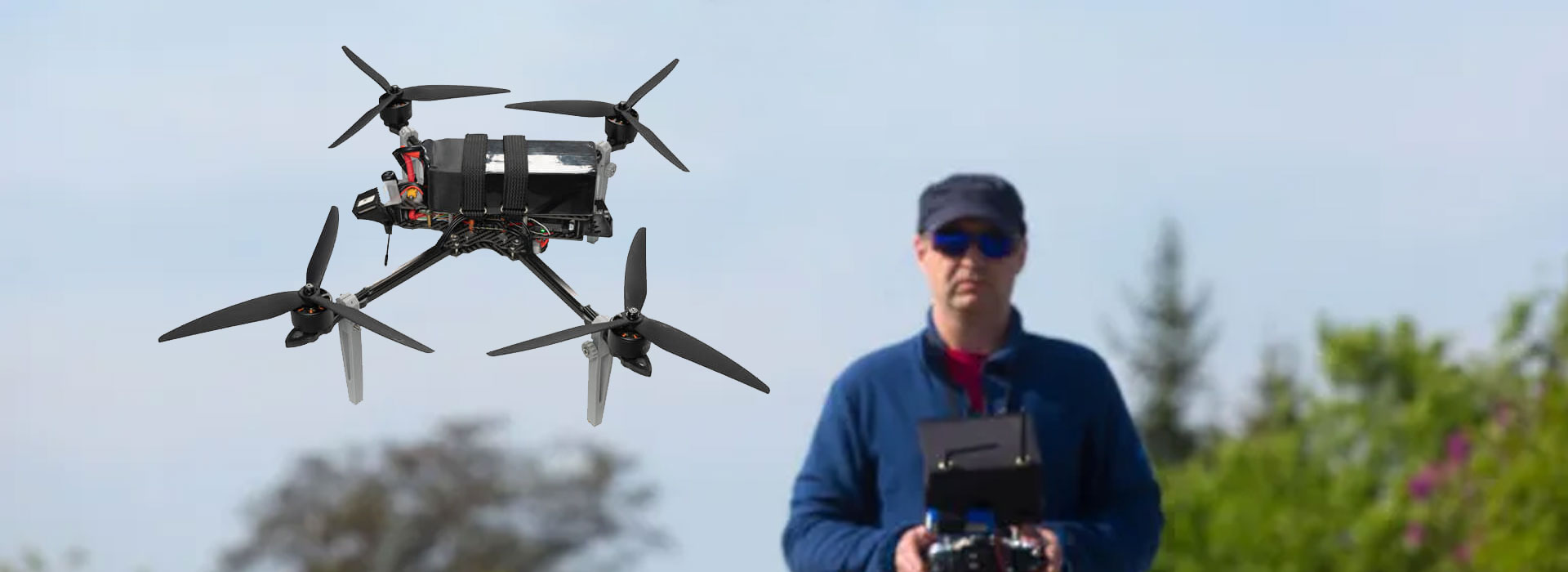
Match a delivered VS50Y revision to an FPV build by comparing the reference photograph's distinctive housing with the received item, then separating label evidence from the supplier's revision statement and technical ratings. The VS50Y Video Transmission Module image shows a circular slotted grille, parallel housing ribs and projecting mounting features. Those clues help identify what to compare; they cannot establish ports, cooling performance or fit. Conflicting brochure numbers remain unresolved. Use a feature-by-feature evidence sheet before installation, and ask for exact-revision documents instead of treating a familiar-looking enclosure as proof that the module matches an accepted build.
Start with the accepted build record
Before opening a repeat delivery, find the record that describes the module accepted for the project. It should identify the ordered model, the supplier's stated configuration and the documents used in the earlier review. If a revision identifier was not available, say so. Do not invent one from a purchase date, photograph name or unofficial label.
A useful build record also names the system boundaries the module was expected to meet. These are project requirements, not facts proven by the module's title. Keep the intended camera source, corresponding endpoint and viewing equipment identifiable in the record. The responsible integrator should supply the evidence supporting their accepted arrangement.
If the project has never accepted a VS50Y configuration, treat the item as an initial evaluation instead of pretending it is a repeat of a tested build. That changes the review question from “is it the same?” to “what evidence is needed?” Receiving can still document the item and included materials while the technical owner resolves its suitability.
Use the photograph for identity evidence only
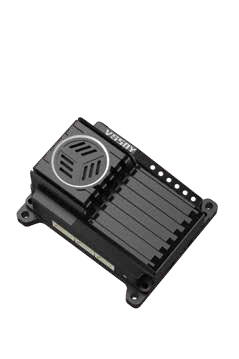
The supplied VS50Y photograph shows mounting flanges and a fan grille on the housing. These details can help distinguish the pictured equipment in a receiving comparison.
A grille does not establish cooling performance, environmental limits or a supplied fan-control function. A mounting feature does not establish dimensions or fit on a particular airframe.
A photograph is useful when the supplier has identified what it depicts. Preserve its source and relate it to the offer or delivered sample. If the received housing differs, record the difference and ask the supplier to explain it. Similarity is supporting identity evidence, not a complete acceptance decision.
The current VS50Y page deliberately omits disputed numeric specifications. Do the same in the receiving record until exact-model evidence resolves them. A neighboring product's table is not a safe substitute, even when a brochure layout repeats the same numbers. Keep the independent VS50Y identity while requesting a corrected configuration sheet.
Compare the VS50Y housing without guessing specifications
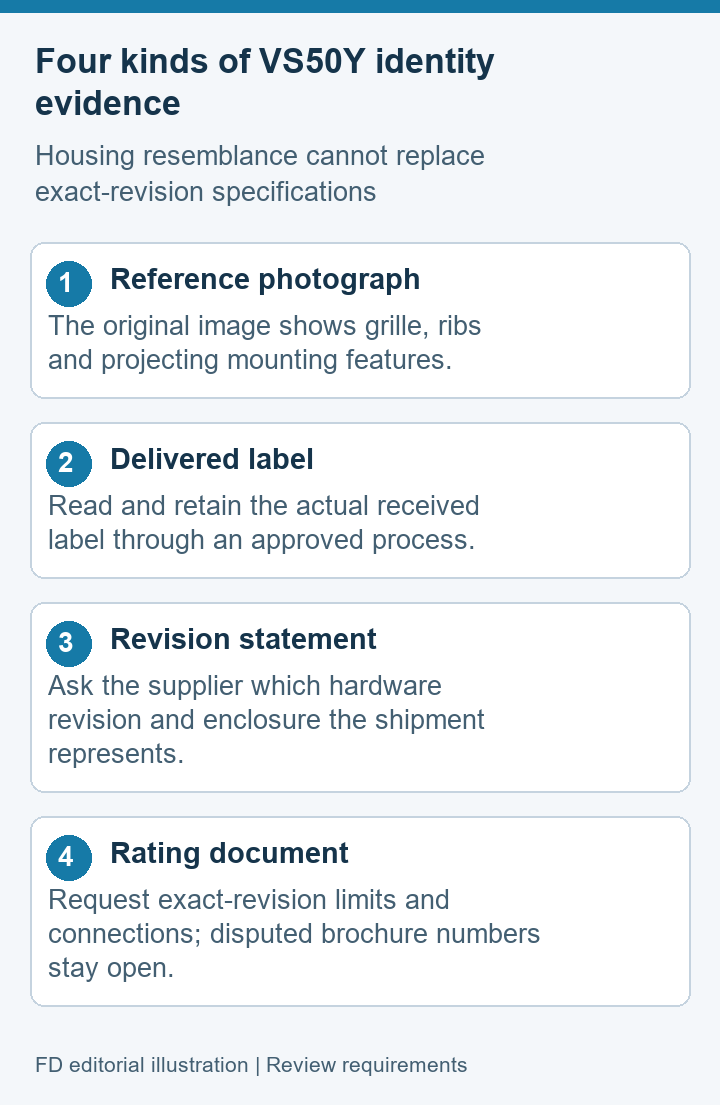
Use four distinct evidence types: the reference picture, a permitted photograph of the delivered label, the supplier's revision statement and an exact-revision specification. Do not let one stand in for the others. This VS50Y comparison sheet starts with visible housing clues; no received sample has been inspected for this article.
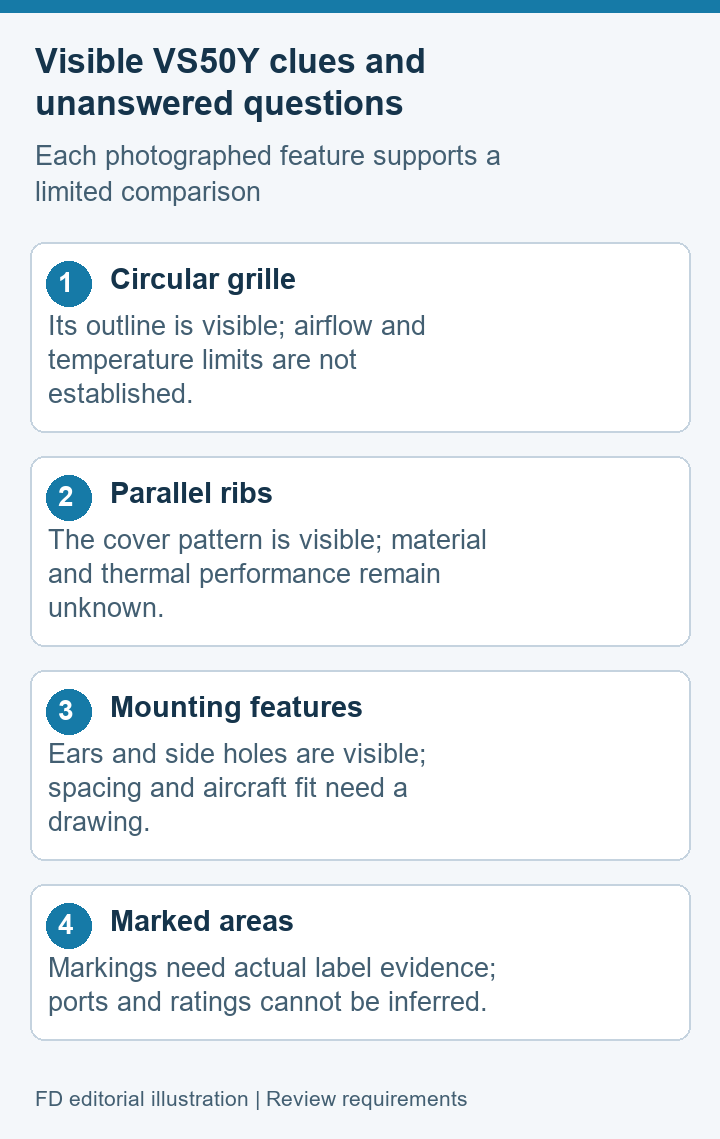
| Reference-photo clue | Check on the delivered item | Specification still unresolved |
|---|---|---|
| Circular slotted grille over one portion of the housing | Compare its position and visible outline in a permitted receiving photograph | Fan operation, airflow, cooling capacity and temperature limits |
| Parallel ribs across the main cover | Record visible differences from the referenced product image | Material, thermal performance, enclosure dimensions and environmental rating |
| Projecting mounting ears and a row of holes along a side | Retain the visible arrangement; request the supplied version's dimensioned drawing | Hole spacing, fasteners, clearance and fit on the proposed aircraft |
| Narrow marked areas visible on the housing | Read the actual delivered label and obtain supplier confirmation of model and revision | Unreadable label details, electrical ratings, connector functions and software compatibility |
Illustrative buyer entry, not an inspected sample: a receiver of a future shipment might write, “Housing photograph comparison pending; delivered model label recorded separately; supplier revision confirmation requested; rating sheet not supplied.” When photographs become available, close only the visible-feature comparison. Even if the grille and ribs appear similar, the missing rating sheet stays open. If a mounting ear differs, preserve that image and ask whether the delivered enclosure belongs to a different revision; do not decide its fit from the picture.
Keep full label photographs in the controlled project record rather than publishing serial numbers or private identifiers. The worksheet should reference the applicable image and document, so another reviewer can see exactly which evidence supports each row.
When an identifier is absent, do not automatically describe the delivery as defective. Ask what traceability the supplier can provide and whether it meets the accepted requirement. The worksheet should preserve the actual situation, not force an unsupported conclusion.
A supplier's statement that a label identifies VS50Y resolves model identity only. Ask separately which hardware revision was delivered and which rating sheet covers it. This matters here because the available brochure image provides a recognizable enclosure while the repeated numeric entries do not establish reliable exact-model specifications.
A receiving note should also name the offer revision used for comparison. When procurement has several drafts, the latest emailed attachment is not automatically the accepted contract reference. The project's normal purchasing record should identify the agreed scope so engineering and receiving are reviewing the same promised item.
Keep undocumented parameters visibly open
Do not populate a specification from resemblance. Electrical limits, video format, connector assignments and supported endpoint behavior require the delivered configuration's evidence. They are not readable from the housing.
List the specific documents needed for the next decision. For example, an integrator may need a version-specific connection drawing and declared ratings before making installation choices. These are requested deliverables, not claims that a particular document is already supplied with VS50Y. The responsible engineer decides which information is essential to the project.
If the brochure and a supplier response disagree, keep both references and request an exact-model correction. Do not select the more attractive number or average the two. A corrected sheet should identify which item and revision it covers. Once clarified, update the accepted record while preserving the reason for the correction.
The project's schedule should not erase the uncertainty. A receiving team can record that a shipment arrived while leaving technical acceptance open. That distinction gives procurement accurate status without suggesting that the module has been proven compatible or ready for installation.
Separate receiving from integration acceptance
Receiving confirms delivery facts: identity evidence, item count and supplied documents. Integration acceptance concerns whether the agreed system fulfills its requirements. Passing the first does not automatically pass the second. Keep the two decisions in separate fields so an inventory check cannot be mistaken for a working-video demonstration.
Before any powered or connected evaluation, the responsible integrator should establish the applicable documents and safe procedure. This article does not provide pinouts, supply values, pairing settings or software configuration. A module whose electrical requirements are unresolved should not be connected by trial and error to produce an acceptance photograph.
For an authorized bench evaluation, record the actual connected equipment, software identities and observed task. Attribute a result only to that configuration and its stated conditions. A view appearing on one screen does not establish all camera formats or endpoints. If the demonstration differs from the intended build, identify the difference instead of describing it as a completed project acceptance.
Keep failed and untested requirements visible alongside passed ones. An honest partial result gives the next owner a starting point and avoids having to reconstruct missing questions after installation work has begun.
Review substitutions before calling them equivalent
Ask the supplier to identify any change from the accepted item or configuration. A new hardware revision, accessory or software arrangement can affect the build even when the model name remains VS50Y. The relevant question is which project requirements and evidence change, not whether the product photograph is close enough.
A concise difference note should name the original reference, the proposed item and the affected rows of the build record. Request supporting exact-revision documentation. The responsible project role can then decide whether existing evidence remains applicable or whether another demonstration is needed. Do not call a substitution equivalent before that decision is recorded.
Retain the accepted decision with the purchase and sample identity. This makes the next order easier to specify and protects future support from a vague reference to “the same video module.” If the supplier cannot establish continuity, preserve the independent item record and treat the technical review as open.
Also update relevant internal documents after approval. A receiving sheet, build inventory and support contact list should describe the same accepted revision. Otherwise, a later technician may ask for documentation that belongs to an older configuration.
Revision-matching questions
Does a matching housing prove compatibility with our FPV build?
No. Appearance can support identity review but does not establish electrical requirements, video format or software behavior. Compare the exact supplied documents with the project's accepted configuration.
Can repeated brochure numbers be used as VS50Y specifications?
The available entries conflict, so they should remain omitted pending exact-model clarification. Request a corrected sheet covering the delivered item instead of borrowing values from another product.
What if there is no visible revision label?
Record that fact and ask the supplier for its traceability method. Do not invent a revision from the purchase date. The project decides whether the available identification meets its acceptance requirement.
Can receiving sign off before integration is demonstrated?
It can record shipment and inventory facts under the organization's procedure. Keep technical acceptance separate and show its unresolved requirements clearly; an item-list check is not proof of system suitability.
What should accompany an approved substitution?
A difference statement, applicable exact-revision documents, relevant evidence and the recorded project decision. Keep it tied to the received item so a repeat purchase and future support use the same reference.
Keep the received item traceable
Identify the offered product with the VS50Y Video Transmission Module reference, then request the configuration evidence needed for your actual FPV build. Keep disputed parameters open until the supplier supplies a reliable exact-model correction.
The useful handover is a traceable item record: what arrived, which documents apply, what differs and who approved the next decision. It lets procurement describe receipt accurately while engineering retains control of integration acceptance. That is more dependable than treating visual similarity or a repeated brochure table as proof of a compatible delivered revision.



 Tel: +86-13959965075
 Email: info@fpvdroneskit.com
 MP/WhatsApp: +86-13959965075
 Manufacturer Address:Quanzhou Valley Nanan Science and Technology Innovation Center, No. 89 Shijing Avenue, Shijing Town, Nanan City, Fujian Province