

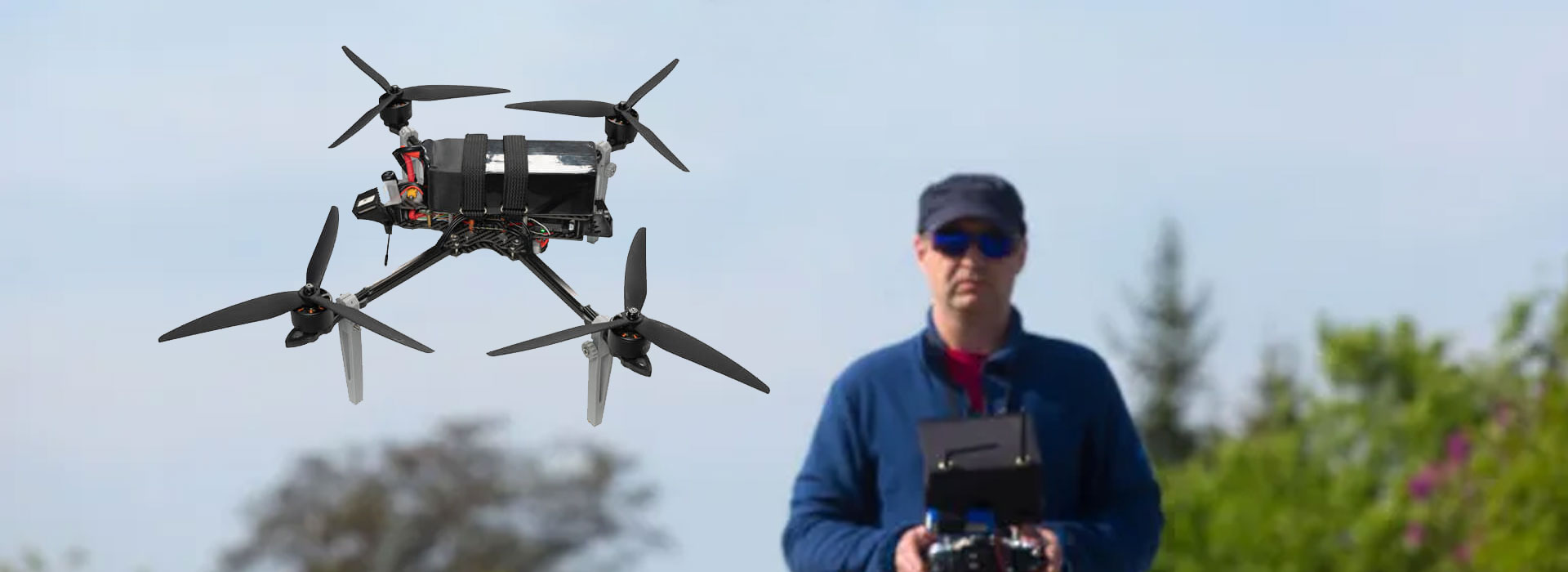
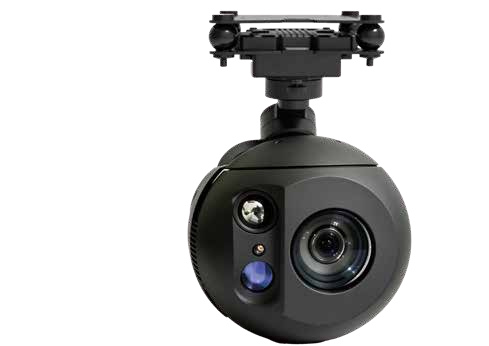
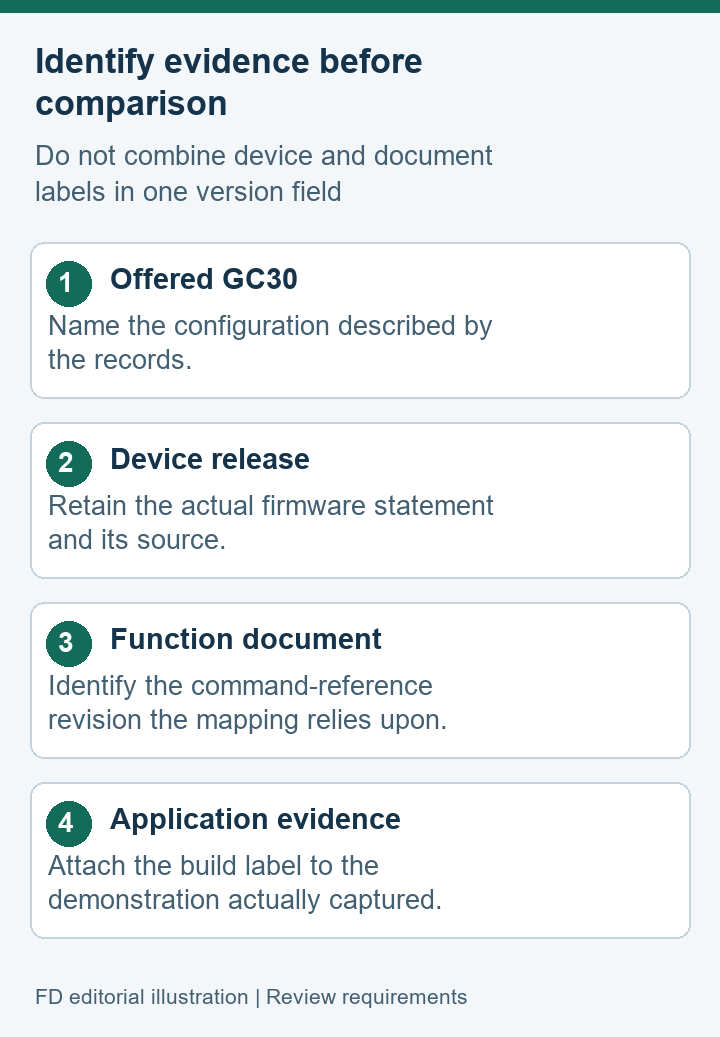
A GC30 handover should identify the camera firmware and the control-protocol documentation separately. The brochure's PWM, S.Bus, UART, TCP and UDP entries name interface families; they do not establish a firmware release, a command-document revision or an application's supported build. For a civil UAV or FPV project, retain the supplier's actual version identifiers alongside the offered camera configuration. Record bridge or application software only where it belongs to that arrangement. This makes a later software question traceable without inventing an installed version, an upgrade procedure or native protocol support that the GC30 source has not established.
Hardware identity and software identity answer different questions
The model name tells a reader which product is being discussed. A hardware revision or offered configuration can narrow that identity further. Firmware identifies software associated with a device, while an application build identifies a different software component. These records may be related, but they should not be collapsed into a single ambiguous version field.
A camera arriving under the expected model name therefore does not, by itself, establish the software state expected by an integration review. The supplier should identify the relevant camera-side information for the offered arrangement. If a separate component runs a bridge or application, its identity belongs in a separate row with its own provider.
This distinction is useful when equipment changes hands. Purchasing may retain the model and package description, while the application developer keeps a software note. Connecting the two records lets a future reviewer identify which software material belongs to which supplied camera. It prevents a product photograph from becoming the only surviving description of an otherwise undocumented configuration.
Take each version label from its stated source
Use the provider's actual identifier when it is available. Avoid inventing a convenient release name to make a spreadsheet look complete. If a version has not been supplied, record that absence and name the requested source. An honest blank with a clear owner is more useful than a plausible label that nobody can trace.
The record should explain where the identifier came from. It may be a supplier document, an identified device-status record or an application information page. This article does not specify which of those sources GC30 provides. The offered arrangement's documentation should identify the appropriate evidence.
A date can help identify a document, but it does not always act as a software version. Keep the original wording so a reviewer can distinguish a document date from a release identifier. Likewise, a file name chosen by a project team should not be presented as the manufacturer's official version label. Both can be recorded if their roles are clear.
When the supplier clarifies an identifier, retain the clarification with the original record. That preserves the reason for a correction and lets the next person understand why an older note used different wording.
A control document needs its own revision
The GC30 interface list describes communication families, but an application developer needs the corresponding function definitions. The command document should be identified by its own title and revision, where the supplier provides those labels. Its relationship to the offered camera firmware should be stated rather than assumed.
A familiar transport name is not a complete command specification. Two devices can use a similar interface family while exposing different actions or message definitions. Keep the model-specific document separate from general architecture references. This prevents an integration team from treating a generic protocol guide as the exact GC30 control reference.
General camera-protocol documentation may include information and capability exchanges. That provides background for software architecture discussions, but it does not establish a GC30-reported version field or native MAVLink implementation. The handover should preserve what the camera supplier actually documents and leave unsupported protocol claims out of the equipment summary.
- Device-side identifier
- The supplier's stated firmware information for the offered camera.
- Control reference
- The function document used by the relevant integration work.
- Application-side identifier
- The named software build responsible for the user-facing function.
Build a version map for the actual offer
A version map should contain only components present in, or explicitly proposed for, the arrangement. It need not assume that every project has a camera manager or a separate companion computer. If such a component is included, identify it; if it is not established, do not add it as delivered equipment merely to complete the diagram.
| Record | Identifier to obtain | Relationship to preserve |
|---|---|---|
| Camera configuration | Offered GC30 identity and revision | The hardware described by the software material |
| Camera firmware | Provider's actual release label | The stated device configuration |
| Control reference | Document title and revision | The functions used by the integration |
| Relevant application | Build identity, if part of the offer | The arrangement its evidence addresses |
The table is an editorial record example. It contains no actual installed GC30 firmware version. The supplier and project team should populate the relevant entries from their own evidence. The useful outcome is a map that explains which document or software record belongs to which component.
Give each row a source and a status. An identified firmware record can be retained while an application statement is still pending. This preserves progress without suggesting that the complete software arrangement has already been demonstrated.
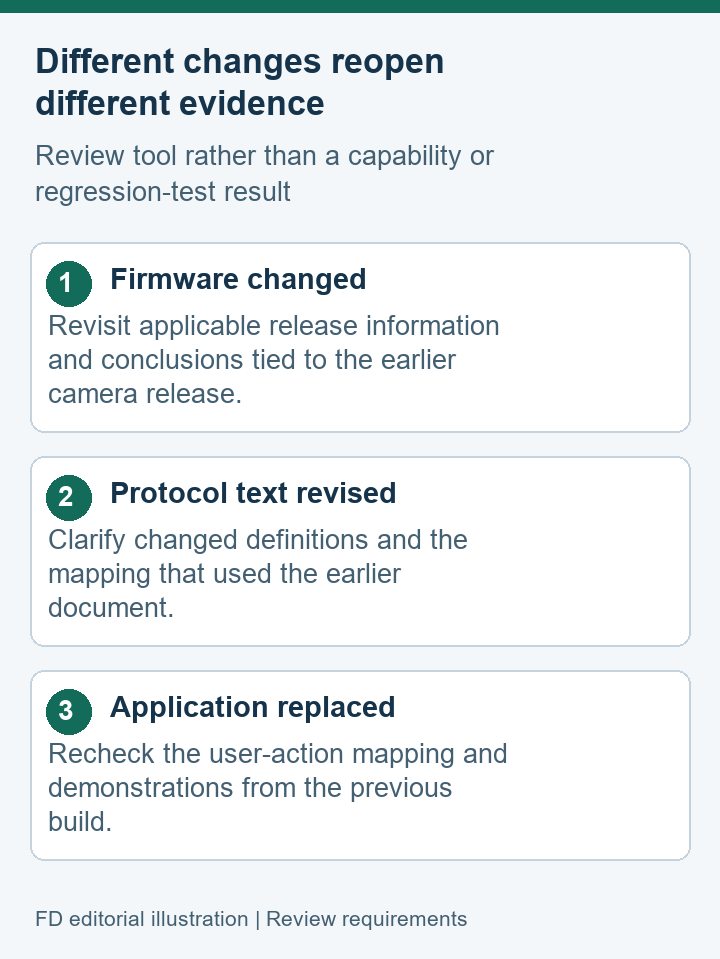
Match a change to the evidence it affects
Firmware, a command document and an application build can change independently. Treating all three as “a new version” hides the evidence that needs attention. The matrix below is an editorial review tool for deciding what to revisit. It describes questions to check, not tested GC30 behaviors or a claim that every listed function exists.
| Changed item | Evidence to revisit | Conclusion to keep pending |
|---|---|---|
| Camera firmware | Applicable release information, supported-function statements and demonstrations tied to the earlier firmware | Whether those earlier camera-side conclusions apply to the offered new release |
| Control-protocol document | Changed function definitions, request/response interpretation and the integration mapping that relied on the older text | Whether the mapping still represents the documented command meaning |
| Application build | User-action mapping, relevant adapter identity and demonstrations captured with the previous build | Whether the requested action is supported in the identified current application arrangement |
For a firmware change, start with the evidence tied to the previous device release. A demonstration may have established one requested action in that arrangement. The new release needs its own applicable information before that conclusion is carried forward. The model name can remain GC30 throughout; that continuity does not answer the software question.
For a document change, first establish what the revised text changes. A corrected description may require clarification of the integration mapping without establishing that the physical camera has changed. Conversely, a revised command definition raises a different question from a new document date with unchanged relevant content. The provider should explain the relationship rather than having the project infer it from the filename.
For an application change, revisit the evidence connecting the user-facing action to the stated camera request. Keep any relevant adapter identified, if the arrangement uses one. An earlier screen recording belongs to the build it captured. Its appearance alone cannot establish that the new application exposes the same documented action.
Do not turn the existence of an update into an automatic instruction to install it. The actual supplier's revision-specific procedure and support scope govern that work. This guide concerns the record surrounding a change, not firmware flashing, recovery steps or a compatibility promise.
A useful outcome from the matrix is a narrow evidence gap. “Application changed; previous camera-side document retained; action mapping not yet reviewed” says what differs and what still needs attention. This is more actionable than discarding every record or declaring the complete arrangement unchanged. Keep separate changes separate when several components are revised together.
Make a software issue report specific
An issue report should identify the arrangement before describing the unexpected result. Name the camera configuration and relevant software records, then state the requested action and observed behavior in ordinary language. This gives the responsible provider enough context to find the applicable documentation.
Keep observation separate from explanation. “The identified application displayed this response after the stated request” describes evidence. A conclusion about which component caused it needs further support. The report can preserve a screenshot or log reference without claiming that the displayed response necessarily originated inside the camera.
Include the point at which the behavior changed, if the project has that information. A record that names the previous and current component identities can be more useful than a general statement that “the camera stopped working.” It helps the provider distinguish a viewing issue, a software mapping question and a different problem without making the report an unverified diagnosis.
Use only the relevant project information. A version record does not need private account credentials or a complete copy of unrelated system data. It should make the technical question identifiable while leaving the provider's actual diagnostic process to the appropriate support channel.
Close the handover with a findable document index
A good index lets a new reviewer find the camera identity, firmware statement, command reference and any relevant application record from one starting page. Keep the provider's documents intact and point to the actual versions used. A collection of filenames without component relationships is much harder to interpret.
The index should also show outstanding information. If the firmware identifier is still awaiting confirmation, state that explicitly and identify its owner. If an application is outside the camera offer, record that boundary. These details help the next person continue the review instead of inheriting assumptions that were never written down.
Use the GC30 Dual Sensor Gimbal Camera model reference for the product's established identity and listed interface families. Retain the actual firmware and protocol material supplied for the chosen configuration beside that identity. A findable version map is a practical handover result even when some integration evidence remains to be completed.
GC30 firmware and protocol record questions
Is a model name sufficient to identify the software arrangement?
It identifies the product under discussion. The relevant firmware, control reference and application records have their own identities. Keep those relationships visible when software evidence forms part of the offer.
Should a project invent a version label when none is supplied?
No. Record the missing identifier and the source expected to provide it. A project file name can organize material, but it should not be presented as an official release label.
Does this article recommend updating GC30 firmware?
It supplies no upgrade procedure or recommendation for a particular release. It explains how to identify records and changes. Actual update work requires the supplier's appropriate instructions for the specific arrangement.
Can an old demonstration be relabelled for a newer application build?
The older record should retain its original identity. Any conclusion for the new combination needs the relevant review. A similar interface or unchanged camera model does not establish that transfer automatically.
Does a revised command document prove the camera firmware changed?
A document revision and a device release are different events. Establish what changed in the relevant text and how the provider relates it to the offered firmware. The review matrix keeps that relationship open until it is supported.

 Tel: +86-13959965075
 Email: info@fpvdroneskit.com
 MP/WhatsApp: +86-13959965075
 Manufacturer Address:Quanzhou Valley Nanan Science and Technology Innovation Center, No. 89 Shijing Avenue, Shijing Town, Nanan City, Fujian Province