Author:Military Drone Manufacturer TIME:2026-10-29
Choose SIYI ZR10 when a 10x optical zoom range meets the visible-detail task and the aircraft benefits from a smaller payload. Choose ZR30 when you need a narrower optical view, a 4K local recording option or a native Micro-HDMI connection. Their headline zoom numbers are not directly comparable unless you separate optical from hybrid zoom: ZR10 offers 10x optical, while ZR30 offers 30x optical. Neither is a thermal camera. Begin with an example of the detail the customer needs to read, then check the aircraft mounting package and video path. A larger number alone does not establish a better inspection result.
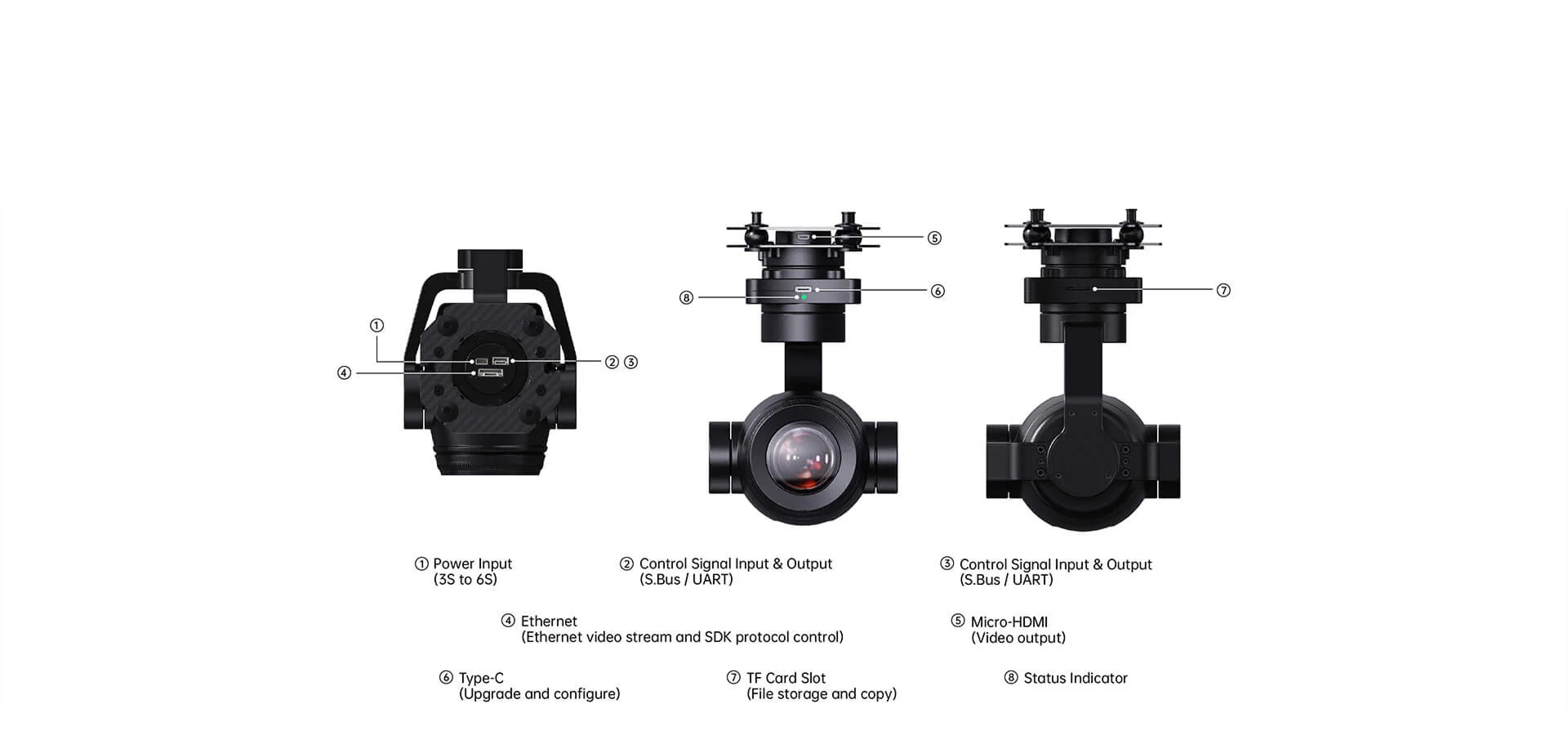
The practical comparison is between two visible-light camera packages, rather than between a basic and universally superior camera. ZR10 can be the more appropriate choice when moderate magnification answers the task. ZR30 adds a much narrower optical view and a different set of recording and connection options. These differences matter more than copying every line of either specification sheet into a quotation.
| Selection point | SIYI ZR10 | SIYI ZR30 | Why it matters |
|---|---|---|---|
| Optical zoom | 10x | 30x | Compare lens magnification before electronic enlargement. |
| Hybrid zoom headline | 30x | 180x | These figures include processing; neither is the optical figure. |
| Horizontal field of view | 71.5° wide; 6.7° at full optical zoom | 58.1° wide; about 2.1° at full optical zoom | A narrower frame covers less of the same scene. |
| Published local recording | 2560 × 1440 at 30 fps | 4096 × 2160 at 25 fps | Local files and transmitted video require separate checks. |
| Native video ports | Ethernet | Ethernet and Micro-HDMI | Select the actual input expected by the aircraft video chain. |
| Published weight basis | 381 g | 668 g including quick-release board | The two entries do not describe identical mounting packages. |
Manufacturer figures describe the listed configurations. They do not prove the clarity of a label, crack or fastener in a particular flight. Use the table to narrow the purchase, then obtain representative files from the intended setup.
Field of view makes the zoom difference easier to understand. At the widest setting, ZR10 shows a broader horizontal scene than ZR30 according to the published angles. At maximum optical zoom, ZR30 shows a much narrower strip. That can help a small feature occupy more of the picture, but it also removes surrounding context. Reading a roof detail and recognizing which part of the roof you are viewing are different visual tasks.
For a simple planning illustration, scene width is approximately twice the viewing distance multiplied by the tangent of half the horizontal field of view. At an assumed 50 m distance to a flat surface viewed squarely, 6.7° spans about 5.85 m and 2.1° about 1.83 m. These are calculated geometry examples, not recommended flight distances or measured camera performance. Oblique surfaces, changing distance and the delivered recording crop alter the result.
The illustration helps answer a useful question: should one frame show a whole component, or a small part of it? Do not interpret the roughly threefold width difference at these telephoto settings as a guaranteed threefold improvement in readable detail. Focus, illumination, vibration and compression still affect the image.
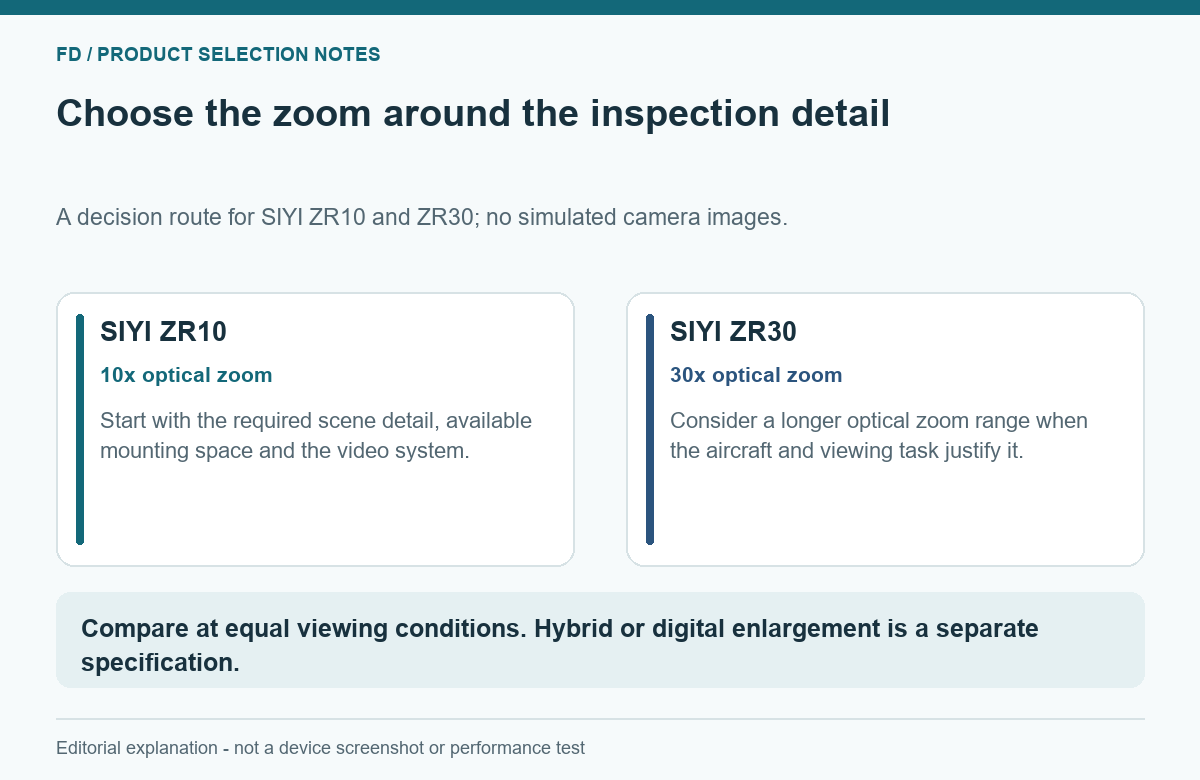
Write the required observation in plain language. “Show the condition of the gutter” is too broad. “Let the reviewer distinguish debris from a damaged gutter edge in the original file” is a better test. If identification depends on readable text, supply an example of its size and contrast. If the purpose is overall construction progress, a wider view may be more helpful than maximum magnification.
Does the required feature remain recognizable in the original 2K recording within the allowed viewing geometry?
Does the narrower optical view reveal the required feature while retaining enough context for the reviewer to understand it?
Ask for an uncropped frame and a short original clip. A full-screen presentation slide, a social-media upload and a screenshot of a zoomed player are poor substitutes. Request both a wider scene and the detail view so that the customer can relate the feature to its surroundings. This makes the comparison about information gained, rather than how large a digitally enlarged image looks.
Optical zoom changes the image formed through the lens. Hybrid zoom can be useful for viewing, but its output does not justify relabelling the camera as 30x optical or 180x optical. Keep the optical setting visible in any sample comparison.
The published 381 g and 668 g entries are useful starting points, but a direct subtraction would hide a mounting difference: ZR30 explicitly includes its quick-release board. The aircraft must carry the complete installed assembly. Add whatever bracket, vibration isolation, power hardware and cables the proposed configuration needs; do not assume they are already inside either quoted weight.
Space can decide the purchase before image quality does. Check the available mounting position, ground clearance and camera movement envelope against current drawings. A payload that fits while stationary may still conflict with an aircraft part during movement. The weight limit also needs the aircraft manufacturer's operating conditions; a nominal carrying capacity does not establish endurance with this particular camera.
ZR30's published controllable yaw range is −270° to +270°. It should not be described as unrestricted continuous rotation. This matters when an application expects repeated movement in one direction. Both models use three-axis gimbals, but that common architecture is not evidence of equal real-world stabilization, nor proof that the heavier choice is better. Comparable stabilized footage needs a comparable installation and scene.
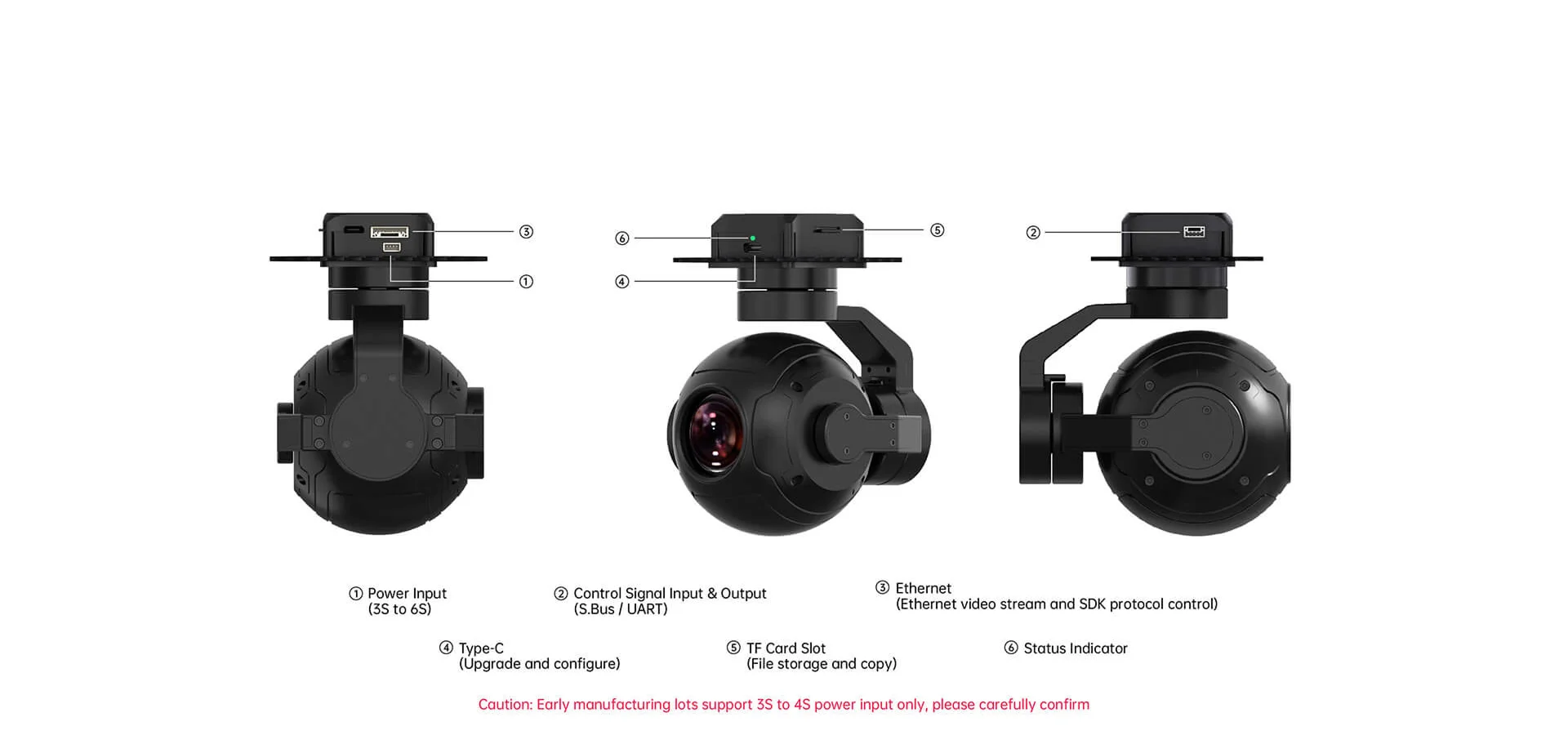
A local recording specification answers what the camera can save. A live output specification answers what the next device can receive. ZR10 lists Ethernet video output; ZR30 adds Micro-HDMI alongside Ethernet. If an existing aircraft video device expects HDMI, this difference may affect the number of components and cables required. It does not establish automatic compatibility with every HDMI or network receiver.
Similarly, ZR30's 4K recording entry is not a promise of a 4K picture on the operator's screen. The encoder, transport, receiver and viewing application all affect the delivered stream. A buyer who needs a high-detail archive but only a modest live preview has a different requirement from one who must read fine detail while watching the screen.
Keep power revision checks separate from video choices. SIYI distinguishes early ZR10 units made before June 2023 from newer batches: the earlier maximum supply value is lower. An existing camera cannot be assigned the newer voltage range simply because a current web page lists it. Identify the supplied revision before connecting it to an established aircraft power system.
General building documentation: a customer needs recognizable roof sections, window surrounds and construction progress images. The intended aircraft has limited payload space, and the required feature is visible in a ZR10 original-file sample. ZR10 is a reasonable candidate; purchasing more magnification would need a separate benefit, rather than an assumption that every inspection needs 30x.
Small visible details within a permitted observation area: another customer already has an aircraft that can accommodate the complete ZR30 assembly. A 10x sample leaves the required feature too small, while a representative 30x optical sample answers the question. ZR30 becomes the stronger candidate, provided the narrower frame and selected video connection also suit the workflow.
These are editorial buying examples, not FD customer projects or field tests. Neither scenario proves a detection distance. If the real requirement is heat-pattern observation, both cameras miss that requirement because this comparison concerns visible imaging. Changing to a thermal or multisensor payload is a different selection decision.
A useful request includes the kind of surface being viewed, the smallest feature that must be understood, the permitted viewing geometry, the required saved file and the available aircraft payload space. Add the live-video input expected by the existing system. This gives a supplier enough context to explain a configuration without guessing what “good zoom” means.
Keep the acceptance question short: can the original file show the required feature clearly enough for its intended review? Ask which optical setting produced it and whether the displayed picture is a local recording or a received stream. For current model details and an appropriate quotation route, compare the SIYI gimbal camera configurations available from FD.
The optical zoom ratios alone cannot establish that. Readable detail also depends on the lens setting, scene, lighting, atmospheric conditions, mounting and the file being examined. Compare representative original files instead of multiplying a claimed distance.
Electronic enlargement can make a picture easier to view, but it cannot be treated as equivalent evidence of additional optical detail. Choose it when the resulting image already answers the observation task, rather than as a guaranteed replacement for a different lens.
A wider picture supplies context, while a narrow picture can enlarge a feature. The better choice depends on the current viewing task. Buyers often need both kinds of sample before deciding how much optical range is useful.
No. A specification is a manufacturer claim under its stated conditions. Without footage made under comparable conditions, it does not prove which camera produces the steadier usable image on a customer's aircraft.
Only when the saved-file requirement benefits from it and the full installation suits the aircraft. If the customer mainly evaluates the received live stream, check that path directly; a local 4K option does not upgrade every part of the video system.
Source basis: SIYI ZR10 and ZR30 official specifications, ZR30 User Manual v1.4, and FD model listings, checked 20 October 2026. The scene-width illustration is calculated editorial guidance. No comparative flight or stabilization test is claimed.

 Tel: +86-13959965075
 Email: info@fpvdroneskit.com
 MP/WhatsApp: +86-13959965075
 Manufacturer Address:Quanzhou Valley Nanan Science and Technology Innovation Center, No. 89 Shijing Avenue, Shijing Town, Nanan City, Fujian Province