Author:Military Drone Manufacturer TIME:2026-11-14
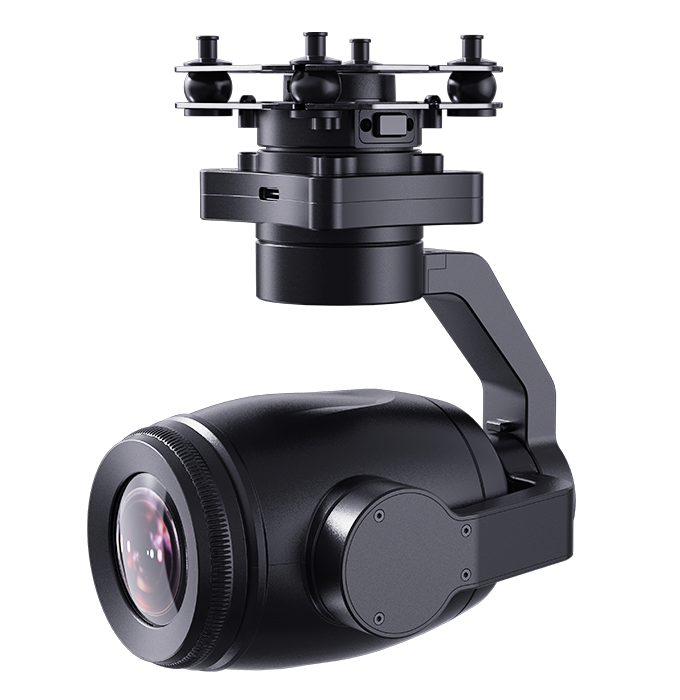
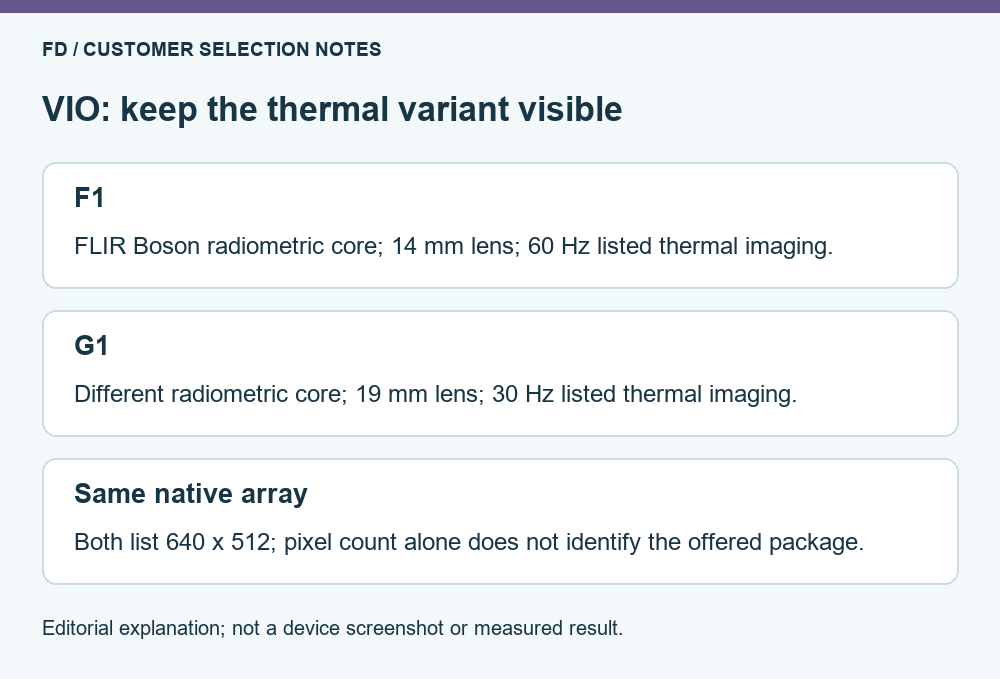
Specify Gremsy VIO F1 by its thermal core and required data result, rather than assuming every VIO configuration has identical thermal behaviour. Gremsy's comparison lists F1 with a FLIR Boson 640 Radiometric core, a 14 mm lens and 60 Hz thermal imaging; G1 uses a different radiometric core with a 19 mm lens and 30 Hz imaging. Both list native 640 × 512 arrays. Those differences can affect which package deserves evaluation, but they do not prove a universal quality winner. Start with the thermal scene, visible-camera task and analysis output, then ask for the exact F1 hardware and software combination that supports them.
VIO is a payload family, while F1 and G1 identify different thermal configurations within the manufacturer's comparison. A quotation that says only “VIO thermal camera” can leave the buyer unsure which detector, lens and relevant thermal formats are being offered. Keep the suffix visible in the request and product identification.
| Published comparison | VIO F1 | VIO G1 | Selection significance |
|---|---|---|---|
| Thermal core | FLIR Boson 640 Radiometric | Thermal core 640 Radiometric | Do not describe them as the same detector package. |
| Native array | 640 × 512 | 640 × 512 | Pixel count alone does not explain the variant difference. |
| Listed thermal lens | 14 mm | 19 mm | Evaluate the framing appropriate to the job. |
| Listed thermal imaging rate | 60 Hz | 30 Hz | Keep imaging rate separate from exported analysis-data rate. |
This is a model comparison from Gremsy's published specifications, not an FD side-by-side flight test or a statement that both variants are included in an F1 order. The offered unit should retain its exact identity throughout the package discussion.
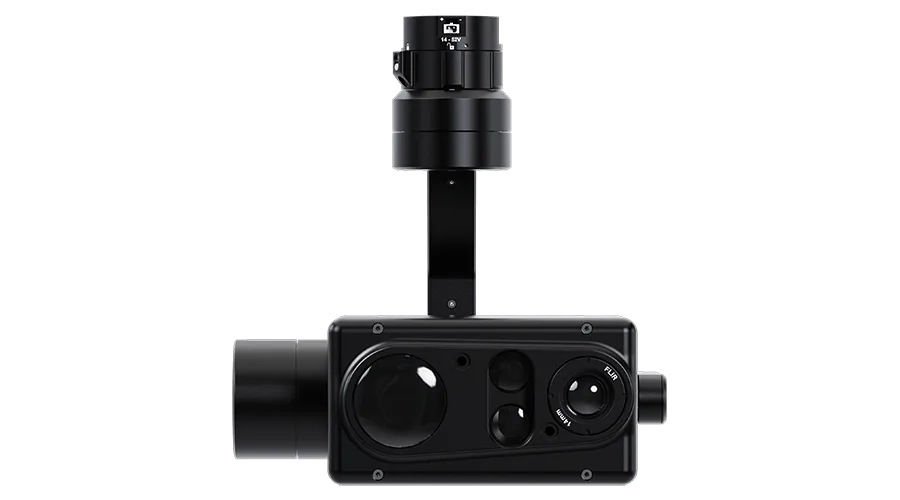
A recognisable core brand can be useful when an existing analysis or integration requirement names it, but the brand name alone does not describe the whole observation task. Define which surface will be examined, the expected thermal conditions and the information the reviewer needs. Then compare the offered configuration with those requirements.
A wider thermal view may help retain context around an inspected area, while a narrower view may place a selected component across more of the frame. The different listed lenses are therefore relevant to sample selection. Do not turn their focal-length numbers into a guaranteed detection distance or assume that the lens which produces a tighter view is always more useful.
Ask to see the subject of interest with enough background to understand where it lies. A thermal close-up without location context can be hard to interpret in an infrastructure report. Conversely, a broad scene that leaves the relevant component too small may not answer the technical question. The right frame is defined by the deliverable, not by the largest number in a comparison.
For example, a customer comparing neighbouring equipment may value a consistent view containing several components, while another needs to examine one selected component more closely. These are illustrative requirements, not claims about the output of either lens at an unspecified distance. Provide the relevant subject dimensions and expected viewing arrangement so that a supplier can propose a meaningful sample rather than an unrelated demonstration.
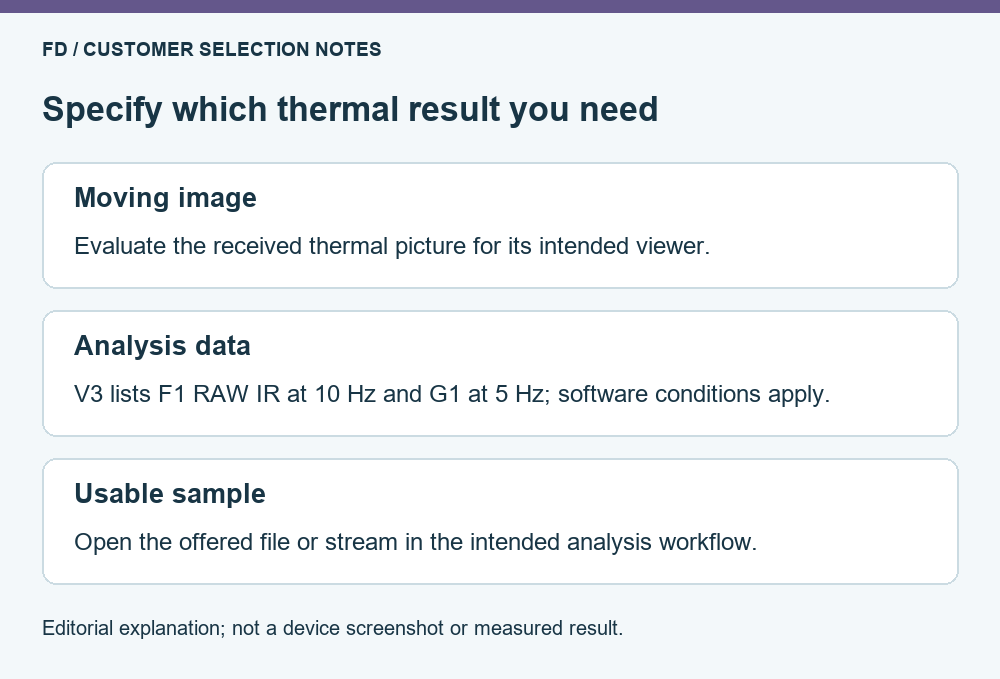
The F1 specification lists 60 Hz thermal imaging. That entry should not be used to promise a 60 Hz export of all temperature data through every software path. Gremsy's VIO Software V3 announcement separately lists RAW IR output at 10 Hz for F1 and 5 Hz for G1. The two sets of figures describe different outputs.
Evaluate the actual received moving image and the format used by the intended viewer.
Identify the required data format, supported rate and software that will interpret it.
A higher imaging frequency also does not establish lower end-to-end system delay. The receiving path, processing and presentation still matter. Buyers should avoid converting a detector-rate comparison into a broad statement that one complete aircraft system has less latency without a relevant measurement.
Radiometry refers to measurement information, but a radiometric detector does not automatically mean that every recorded JPEG or MP4 is suitable for every thermal-analysis application. A temperature label over a runtime image and a data file that supports later analysis are different deliverables. Ask for the one the customer's process needs.
Describe the intended action: review an apparent surface pattern, read a displayed measurement during observation or perform later numerical analysis using a specified application. The supplier can then discuss the relevant F1 software and output support. This is more precise than asking whether the camera “has radiometry” and accepting a general yes.
Request an actual sample from the offered configuration. Open it in the proposed analysis environment and check the required operation. Do not assume that FLIR core branding establishes a particular FLIR file container or that a conventional video recording preserves all the data required by a downstream tool. File capability needs its own evidence.
Agree on a simple acceptance action before the sample arrives. The reviewer might need to select an area, inspect its available thermal values and retain the result in the project format. If that action cannot be completed, describe the missing step directly. An attractive thermal video is not a substitute for the numerical operation that justified choosing the radiometric configuration.
The current V3 announcement shows why a software version can change the relevant deliverable. It describes a combination of payload, video-stream and web-settings applications, while companion SDK and service tools are updated separately. A buyer requesting a specific RAW IR output should discuss the complete supported combination rather than only naming the camera housing.
Gremsy also states firmware prerequisites and a restricted upgrade route. That makes an existing unit and a newly supplied unit different procurement situations. An article should not tell a customer to install a random software file to obtain a promised feature. Ask the manufacturer or supplier for the configuration appropriate to the exact hardware and required result.
Keep this distinction practical: specify the necessary output in the purchase request and have it demonstrated. There is no benefit in collecting version numbers without a reason. The reason here is whether the delivered F1 can provide the thermal output that the buyer's viewing or analysis task requires.
F1 is an EO/IR payload, so thermal configuration is not the only purchase variable. Gremsy lists a visible camera with 20x optical zoom in the VIO family. A buyer using thermal patterns to identify an area may still need a visible record that lets another person recognise the equipment and understand its condition.
Specify the visible result separately from the thermal result. If the report needs readable component detail, evaluate that requirement using an appropriate original visible-camera sample. A satisfactory thermal view does not establish the clarity of the visible detail, and optical magnification of the EO camera does not describe the thermal lens.
The aircraft also carries the complete EO/IR assembly. Use the offered quick-release, damping, cable and mounting scope when considering platform fit. The choice of core does not establish endurance, mechanical compatibility or stabilised image quality on a particular aircraft. Those questions require the corresponding installation evidence.
Retain the ability to understand a thermal finding in ordinary visual terms. A useful paired sample shows the relevant component in each channel and explains which view is being examined. It should not require the buyer to guess whether a picture is an EO frame, a thermal rendering or a combined layout from a ground application.
A useful inquiry names VIO F1, the intended aircraft, the thermal observation or analysis task, the required file or stream and the viewing application. Add the visible-camera detail that matters. If a project has an explicit FLIR-core requirement, explain that requirement so that the supplier can keep the F1 identity clear.
For an existing installation, include the physical unit identification and its current supported software context. For a new package, ask what hardware and software are included to demonstrate the requested result. A quotation should not silently substitute G1 because both models share a 640 × 512 native array.
For the offered F1 product and a discussion of the required thermal result, review the Gremsy VIO F1 EO/IR payload from FD. Choose around a useful demonstrated output, rather than a general assumption that a detector brand, frequency or payload-family name answers every integration question.
No. Gremsy's comparison distinguishes their thermal cores, lenses and imaging rates. Native pixel count is only one property and should not erase the model suffix in an order.
No. The V3 announcement separately lists F1 RAW IR output at 10 Hz. Keep the relevant software and output path with that figure instead of copying the thermal imaging rate into a data-export promise.
That requires a format-specific demonstration. A core capability, runtime overlay and exported analysis file are different parts of the system. Ask for an actual sample and open it in the intended tool.
Consider framing, required output and the complete viewing or analysis task as well. A higher detector rate is not independent evidence of better calibration, sharper images or lower whole-system delay.
No. Their lenses, outputs and purposes differ. Name the required visible detail and thermal result separately so that the supplier can explain a configuration without mixing channel specifications.
Source basis: Gremsy VIO current specifications, product description and VIO Software V3 announcement, plus the FD F1 listing, checked 21 October 2026. No comparative flight, calibration or latency test is claimed.

 Tel: +86-15059599996
 Email: info@fpvdroneskit.com
 MP/WhatsApp: +86-15059599996
 Manufacturer Address:Quanzhou Valley Nanan Science and Technology Innovation Center, No. 89 Shijing Avenue, Shijing Town, Nanan City, Fujian Province