

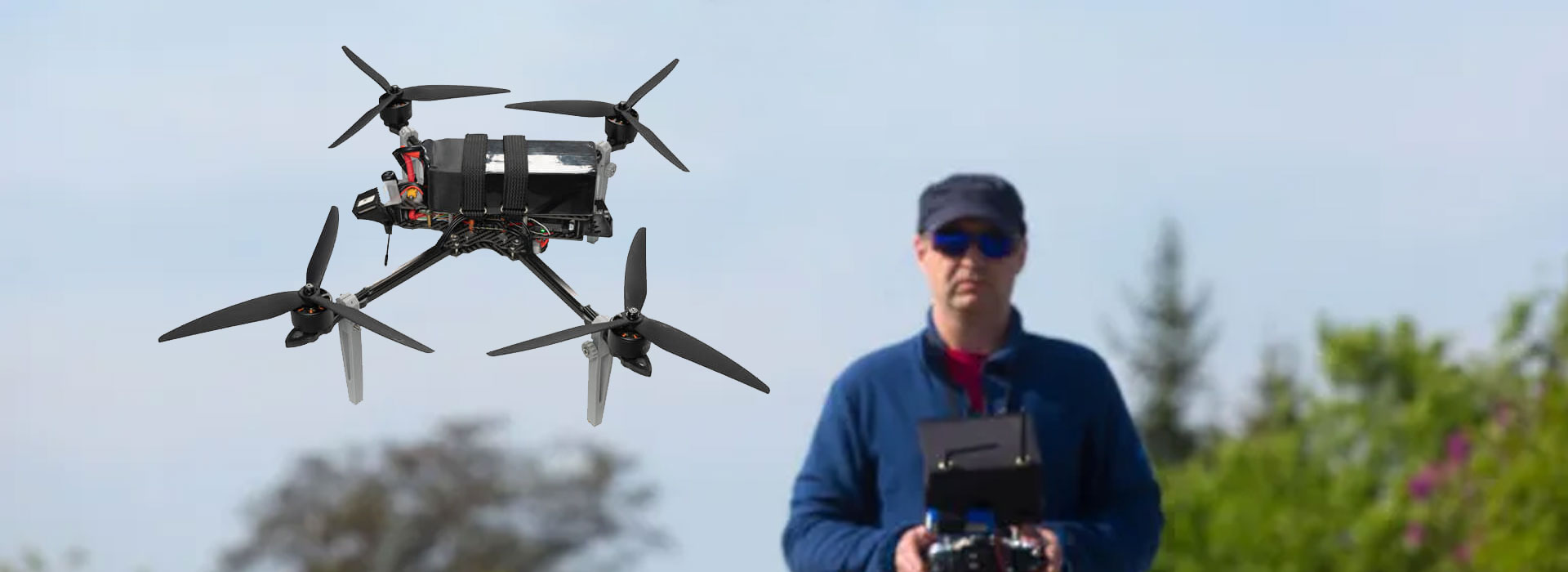
A GC30 electrical review needs three separate statements: what the camera requires, what the proposed platform supply provides, and what the selected cable is rated to carry. Compare those documents before treating the package as an agreed power arrangement. The available GC30 brochure does not establish its supply limits, consumption or complete cable contents, so the comparison below deliberately retains missing entries. For a civil UAV or FPV project, this is a paper review tool: it shows which evidence needs attention and keeps a declared component rating separate from compatibility or a tested electrical result.
Begin with the offered camera configuration
An electrical document is useful only when the team knows which equipment it describes. Start with the offered GC30 assembly and its relevant revision or configuration identity. A document for another camera, or for an unidentified version, should not silently become the power reference because it contains a convenient table.
The source material identifies the camera's visible and thermal imaging roles and a three-axis gimbal. It does not provide a complete electrical definition for the arrangement being purchased. Keep that limit visible in the document index. The model identity can be established while the power information is still awaiting a configuration-specific response.
For example, purchasing may have a camera offer and the aircraft integrator may have a proposed supply component. The two descriptions need to meet through the relevant documented requirements. A model name alone does not establish that they form an accepted combination. The review should identify the evidence used to connect those two sides and name any remaining gap.
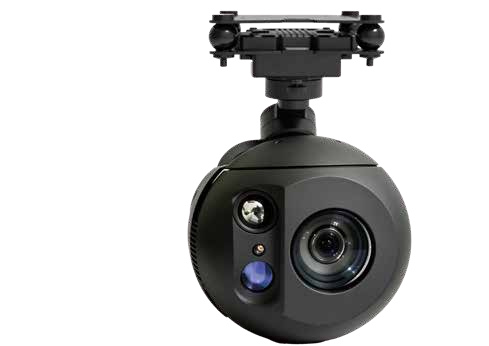
Give supply information its own document
A power reference should identify the camera-side requirements in the terms supplied by the manufacturer or responsible vendor. The integrator also needs the documentation for the proposed supply arrangement. Keep these documents separate enough that a reader can see which statement belongs to which piece of equipment.
Do not fill a GC30 power row with a value from the GC10 manual. The two products have distinct identities, and the availability of a detailed reference for one does not establish the other. Similarly, an imaging specification or a video-interface entry cannot supply a missing electrical rating. The offer should retain that item as unresolved until the correct documentation is available.
Separate the document's stated rating from the conditions attached to it. A camera input specification and a supply output declaration concern different equipment; their headings should remain visible when someone copies a value into a worksheet. Preserve the units and stated conditions as written. If a record provides only a broad product name, the row remains a documentation gap rather than a completed electrical comparison.
Identify the selected cable rather than a generic family
The camera source names several interface families, but a selected cable needs a more specific description. Identify the actual supplied or proposed part, its role and the documents that apply to it. “Camera cable” can hide a substantial difference between a standard-looking lead, a project-specific harness and a cable included with a particular offered assembly.
A useful cable entry distinguishes the connector identity from the assembly's documented ratings and role. Keep the relevant cable or harness specification beside its part number, including electrical limits where the provider states them. The picture can help recognize the part, but its appearance does not establish a voltage or current rating. Never fill a missing cable specification with the camera's own input requirement.
A cable can also have a project owner. The camera supplier may provide it, the platform integrator may select it, or the arrangement may still be undecided. State that responsibility in the offer rather than leaving both parties to assume the other supplies it. An unresolved cable entry is easier to handle before delivery than an unexplained omission discovered during equipment handover.
Keep electrical roles distinct from picture delivery
GC30 lists HDMI and IP video and several control methods. These entries help describe communication roles. They do not, by themselves, define how power is supplied to the offered camera. A project record should keep the power arrangement identifiable even when the physical equipment is discussed as one integrated payload.
Write the purpose beside each selected connection in the equipment schedule using the supplier's actual documentation. A reviewing team should be able to find the record for picture delivery, the record for the relevant control interface and the record for power. This does not require the article to specify a wiring arrangement or imply that every role uses a separate cable.
When a demonstration shows the camera and a screen together, ask which equipment supplied power in that demonstrated arrangement. That is an identification question, not proof that the same supply is included in a camera-only offer. Keep the demonstration's component list separate from the purchase's delivered-items list unless the supplier has explicitly reconciled them.
Record what is supplied and what the project provides
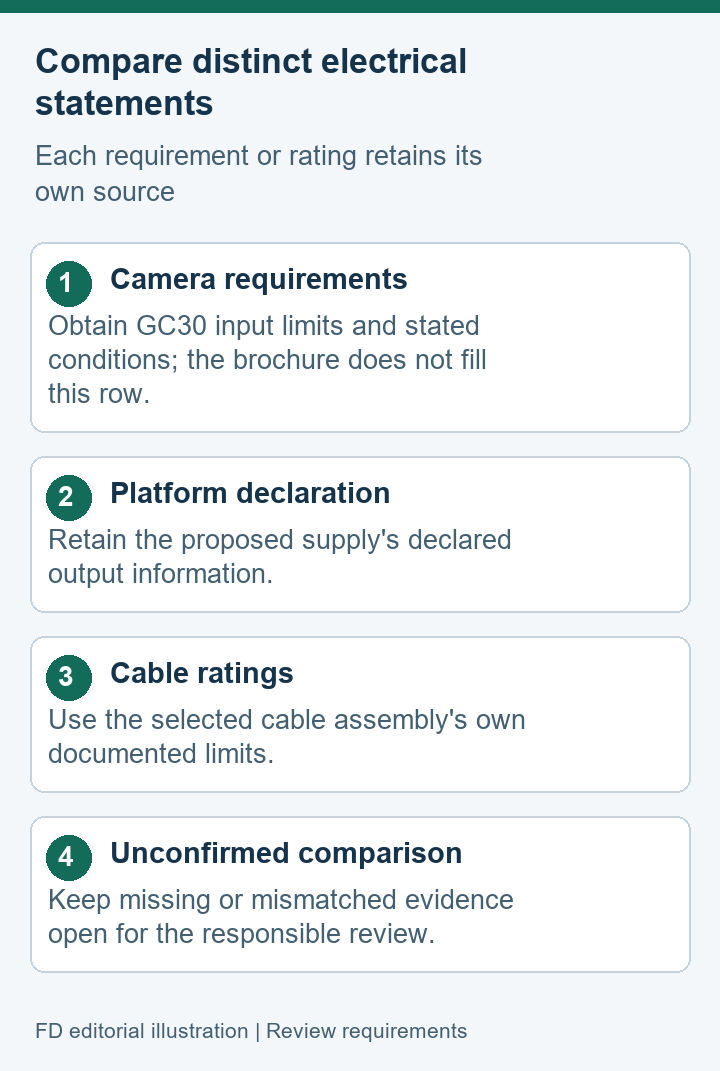
Use a comparison sheet that preserves each source's role. Camera requirements belong in the camera row; a platform-side declaration belongs in the supply row; cable ratings belong to the exact cable assembly. The last row records unanswered comparisons. None of these roles can be completed by copying a familiar value from a different model.
| Record category | Statement to retain from its own source | Comparison or unresolved evidence |
|---|---|---|
| Camera electrical requirements | Input limits, consumption description and stated conditions for the offered GC30 | Not established by the reviewed brochure; obtain the applicable camera record |
| Platform power declaration | Selected supply identity, declared output limits and their conditions | Compare with the camera requirements through the responsible electrical review |
| Cable assembly ratings | Exact part, stated electrical ratings and documented connection role | Assess that cable's stated scope against the selected arrangement; photograph alone is insufficient |
| Unconfirmed items | Missing record, different model reference or condition that cannot be compared | Keep the particular mismatch or absence open; do not mark the complete arrangement accepted |
Read across the categories before assigning a review status. If the platform document is present but the GC30 input limits are absent, the worksheet has one supplied statement and one missing requirement. It has not established an electrical match. If a cable is included commercially but has no applicable rating record, its delivery status can be known while its technical evidence remains incomplete.
A completed sheet still needs the appropriate electrical assessment. Matching printed numbers would not, by itself, establish every connection detail, operating condition or complete installation result. The sheet's narrower job is to expose the information being compared. Its conclusion should therefore identify which documented comparison was reviewed and which questions remain outside it.
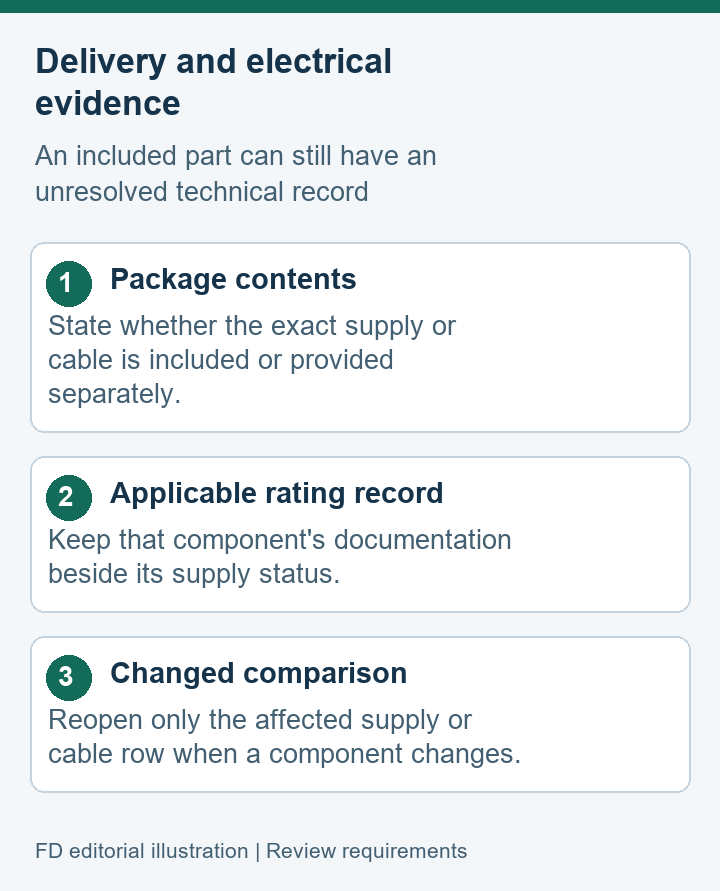
Give the receiving team a separate included-parts list. That list answers whether the stated supply or cable arrived; the comparison sheet answers what information supports its proposed role. Keeping both records makes it possible to report a missing accessory without confusing it with an unresolved electrical specification.
Resolve substitutions before carrying an old conclusion forward
A substitution may leave the camera model unchanged while altering the relevant arrangement. A different supply component, cable or assembly revision should therefore appear in the change record. The earlier review may still contain useful information, but its conclusion should not automatically transfer to unnamed replacement parts.
Reopen the row affected by the substitution. A different platform supply calls for its own declared output record to be compared with the camera-side requirements. A changed cable calls for that assembly's applicable ratings and connection-role information. Neither change can be represented simply by leaving the old worksheet's accepted label in place.
If the replacement part has not been identified, mark that exact item pending. A camera requirement need not be erased merely because the platform-side evidence changes; instead, preserve it as the requirement awaiting a new comparison. This keeps stable source information useful while preventing an earlier component assessment from silently covering an unnamed replacement.
“Camera requirement record available; proposed supply declaration replaced; cable rating record still missing. The revised combination has not received an electrical compatibility conclusion.” These are documentary states, with no invented GC30 voltage, current or sample test.
Make the handover useful to the next integrator
A handover should let another person locate the correct documents without reconstructing a series of conversations. Put the offered camera identity, selected supply record and cable list in one index. Give the relevant files clear names and revisions. Their contents can remain with their original authors rather than being copied into a new unofficial specification.
Record which items arrived and which project items are separate. A delivery photograph can identify the visible contents of one received package, but the document index should still state the complete agreed scope. If a cable or electrical record is missing, keep that gap visible and identify the party responsible for resolving it.
For model identity and the listed communication interfaces, refer to the GC30 Dual Sensor Gimbal Camera product information. For the actual power and cable arrangement, retain the configuration-specific supplier material. An accurate handover should make it easy to see both the established facts and the information still needed.
GC30 power and cable scope questions
Can the GC10 power reference be used for GC30?
The products have separate identities. The available GC30 material does not establish that the GC10 electrical reference applies. Obtain the document for the offered GC30 configuration rather than transferring a convenient value.
Does an HDMI or IP entry identify the complete power arrangement?
Those entries describe video-interface families in the source. The power arrangement requires its own documented equipment identity. No electrical supply method is inferred from the listed video output here.
What belongs beside a cable in the purchasing record?
Name the actual part, its stated role, the supplying party and the applicable documentation. Add whether it is included, separate or unresolved. A generic cable description cannot establish all of those details.
How should an unconfirmed accessory be shown at handover?
Keep its status explicit and identify the missing information or supply responsibility. Do not present a proposed part as received equipment or infer inclusion from a photograph of a different demonstration package.
Does a completed document comparison prove electrical compatibility?
The sheet organizes stated requirements and ratings for review. It is not a compatibility test or installation approval. The responsible assessment must address the actual components, documented conditions and unresolved connection details.

 Tel: +86-13959965075
 Email: info@fpvdroneskit.com
 MP/WhatsApp: +86-13959965075
 Manufacturer Address:Quanzhou Valley Nanan Science and Technology Innovation Center, No. 89 Shijing Avenue, Shijing Town, Nanan City, Fujian Province