Author:Military Drone Manufacturer TIME:2026-11-16
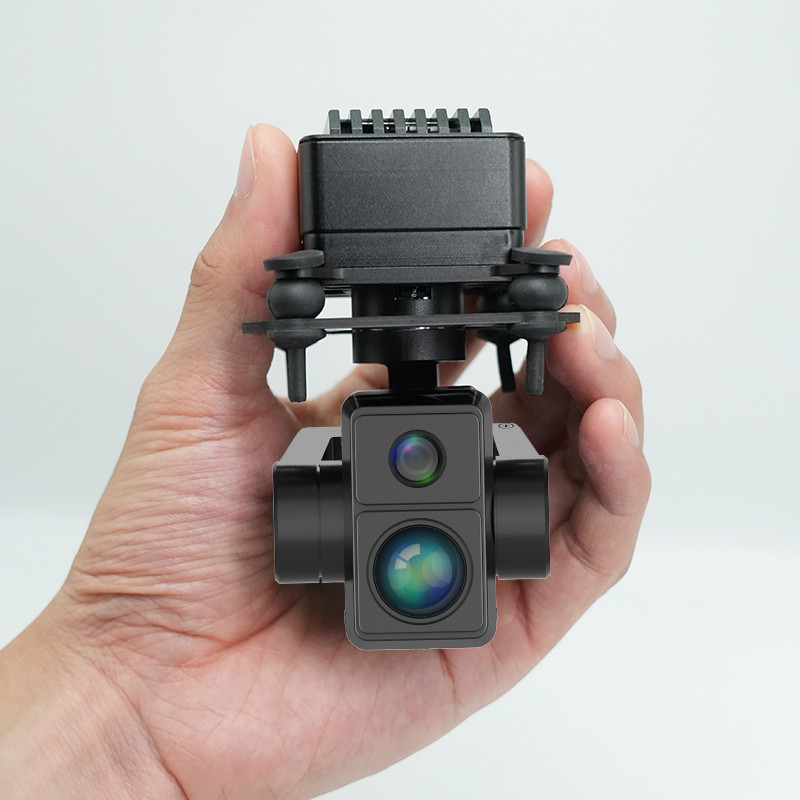
Choose Recon Eye-K3T over the visible-light K3 when your small-drone inspection has a specific thermal observation requirement, rather than treating the T suffix as a general quality upgrade. YANGDA identifies K3 as an EO camera and K3T as an EO/IR package with native 640 × 512 thermal imaging. K3T also has a different visible-camera specification and digital enlargement capability. Those differences can be valuable, but they add a second kind of information that the customer must actually need and interpret. Define the required visible record, the thermal question and the complete aircraft package before deciding which model to request.
The deciding question: would the customer make a different, justified inspection decision using the thermal view, or does the required result depend entirely on visible condition?
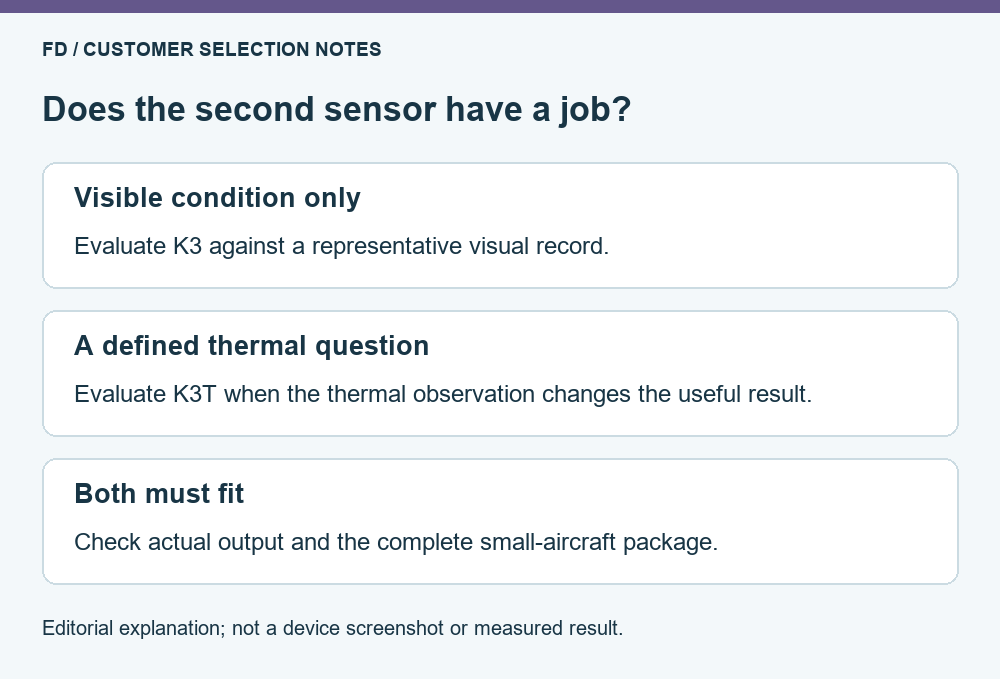
Visible imagery can document appearance, location and many readily observable conditions. A facilities review may need a clear record of a roof section, an access route or the visible state of equipment. If that is the complete requirement and a representative sample supplies enough information, a pure visible-light camera remains a reasonable class to consider.
Thermal imaging answers a different question about the apparent thermal pattern of a scene. It is useful only when that additional observation is relevant to the task and the reviewer has an appropriate interpretation method. Adding the channel does not automatically make every visual record better or turn an ordinary appearance check into a diagnosis.
Write down what the reviewer could conclude from each channel. If the thermal requirement cannot be described more clearly than “it might be useful,” evaluate its purpose before making it the deciding purchase feature. A defined question makes the comparison between K3 and K3T far easier to understand.
Consider who receives the result. An operator may watch the live picture, while a maintenance reviewer receives selected files several hours later. Their needs can differ: the first needs a usable view during the job, and the second needs sufficient context and a clear explanation of what was observed. Specify both roles when a purchase must serve them both.
YANGDA's current K3 page describes an entry-level EO camera with a 2592 × 1944 visible-camera specification. Its K3T page identifies an EO/IR configuration with an 8 MP visible camera, 40x digital zoom and an 18 mm thermal lens. Keep these descriptions attached to their own models.
| Selection point | Recon Eye-K3 | Recon Eye-K3T |
|---|---|---|
| Basic imaging role | Visible-light EO | Visible plus thermal EO/IR |
| Current visible-camera entry | 2592 × 1944 | 8 MP; digital enlargement listed |
| Thermal detector | Not part of this model's primary specification | Native 640 × 512 |
| Thermal enhancement headline | Not applicable | 1280 × 1024 enhanced image |
| Useful first sample | A representative visible condition record | Visible context paired with the required thermal observation |
The same brand and a similar compact appearance do not make the products interchangeable. Model identity should remain explicit when requesting samples, considering a replacement or comparing package prices.
For a building or equipment inspection, a useful thermal question may concern a region that appears different from adjacent surfaces under a defined method. The thermal view can direct attention, while the visible image helps the reviewer identify the corresponding component. The result still needs interpretation; a coloured region does not explain its own cause.
A thermal image also does not automatically provide a specified temperature-analysis workflow. The K3T page's detector and enhancement entries should not be treated as a promise that any desired radiometric file or temperature report is included. If numerical analysis matters, request the precise offered capability and a usable sample before relying on it in a proposal.
Keep the need for low-light visible observation separate from the need for thermal imaging. A thermal camera forms a different image, rather than simply producing a brighter version of the visible frame. If the customer must read visible markings, the thermal channel does not replace the visible-camera sample needed to establish that result.
For a paired inspection sample, choose an ordinary component that the reviewer can identify in the visible frame. Then examine what the thermal image adds under the stated conditions. If the second view does not answer a separate question, explain that honestly. A dual-sensor purchase should follow from useful additional information, rather than from an assumption that more channels always produce a better report.
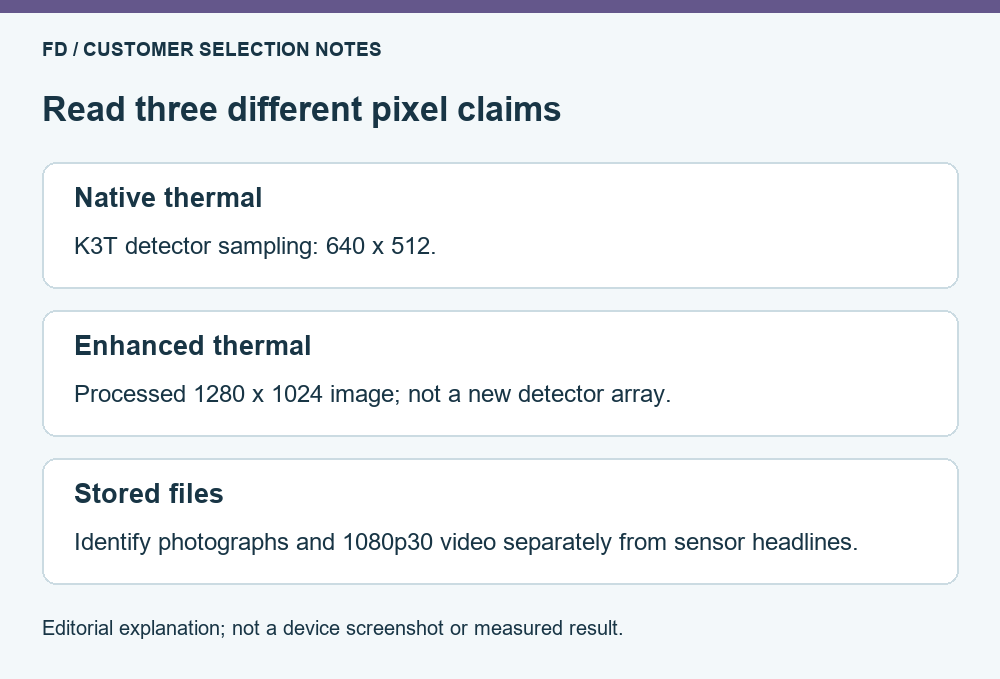
K3T's thermal detector is specified as native 640 × 512, with an AI-enhanced image of 1280 × 1024. The enhanced dimensions do not mean that the detector has four times as many independent native sensing elements. Compare the actual image the customer will use without relabelling the sensor.
The visible-camera headline requires the same discipline. An 8 MP visible entry and a 3840 × 2160 JPEG entry are not proof of 4K video recording. The K3T model table lists MP4 video at 1080p30. K3's table also distinguishes its visible-camera pixel entry from its stored JPEG and video entries.
This matters when the final deliverable is a saved inspection clip. A buyer can be satisfied with a high-resolution still and disappointed by a video chosen on the wrong assumption. Name still photographs, local video and the live received picture separately in the request. They may serve different parts of the same job.
Look at the original file properties as well as the picture shown in a demonstration. A player window can enlarge a small file, and a presentation can combine pictures from different channels. Neither tells the buyer which format the camera actually saved. The sample set should make its source and channel obvious without requiring a technical investigation by the customer.
The K3T product description lists 40x digital zoom. Do not rewrite that as 40x optical zoom or assume it guarantees new visible detail at a particular distance. Electronic enlargement may make existing information easier to examine, but its usefulness should be judged in an appropriate original sample.
The reviewer needs to recognise where the enlarged component lies in the broader structure.
The required feature must remain understandable in the actual saved or received image.
If the required small feature is not adequately shown, that is a reason to evaluate the lens and complete camera class. It is not a reason to multiply the digital number or assume the thermal channel compensates for missing visible information. Each part of the package should answer its own required observation.
Compact product photographs can hide the practical differences between two installations. Check the offered mounting pieces, cable arrangement, movement clearance and supported video/control functions for the selected model. A quick-release description does not establish compatibility with every small aircraft or every existing bracket.
The current K3T page contains different weight figures in separate parts of its presentation. Rather than selecting the most attractive number, request the weight and assembly scope for the offered revision. The aircraft carries the complete installation, so board, bracket and cable scope matter alongside the camera body.
A control-system name or protocol family in a product description is also not universal integration evidence. Ask for the supported combination appropriate to the intended aircraft and viewing application. A customer choosing a second sensor should not discover that a desired view or camera function is unavailable in the package being quoted.
Plan where the extra information will appear on the operator's display. A dual-view layout may help comparison, but each view still needs to remain large enough for its intended purpose. Ask for the actual proposed screen arrangement instead of assuming a product photograph describes how the pilot or reviewer will use both channels.
Visible condition documentation: a team needs recognisable records of equipment placement and surface appearance. A representative K3 output answers the requirement, and no thermal question has been defined. K3 remains a candidate; there is no need to describe the absence of a second sensor as a quality failure.
A defined thermal observation alongside context: another team has a documented inspection question that requires the apparent thermal pattern and a visible view to locate the component. K3T becomes the relevant candidate if its actual outputs and complete installation support that task. The extra channel has a purpose that the buyer can explain.
These examples are hypothetical purchasing situations, not FD project results. For current options, compare the YANGDA gimbal camera models available from FD. Include the required observation and sample output when requesting a package, so the comparison remains about useful information rather than suffixes or untested quality claims.
It identifies a different imaging package. The additional thermal channel matters when the job needs it. A pure visible-light requirement should still be evaluated against a suitable visible-camera sample.
The current model page identifies native 640 × 512 with an enhanced 1280 × 1024 image. Keep detector sampling and processed image dimensions distinct in both selection and quotation language.
No. YANGDA labels it digital zoom on K3T. Treat it as electronic enlargement and inspect a relevant sample instead of assuming optical magnification or a guaranteed detail distance.
Not when the required information is visible appearance or readable markings. Thermal patterns and visible appearance are different observations. A report may need both, with enough context to relate them.
Ask for the exact model, current assembly weight, included mounting and cables, supported viewing path and representative output. Without those details, two prices may refer to different packages and different results.
Source basis: current YANGDA K3 and K3T model descriptions and specification tables, plus FD listings, checked 21 October 2026. Misplaced K3T FAQ text on the K3 page is not used as a K3 capability source.

 Tel: +86-15059599996
 Email: info@fpvdroneskit.com
 MP/WhatsApp: +86-15059599996
 Manufacturer Address:Quanzhou Valley Nanan Science and Technology Innovation Center, No. 89 Shijing Avenue, Shijing Town, Nanan City, Fujian Province