Author:Military Drone Manufacturer TIME:2026-10-31
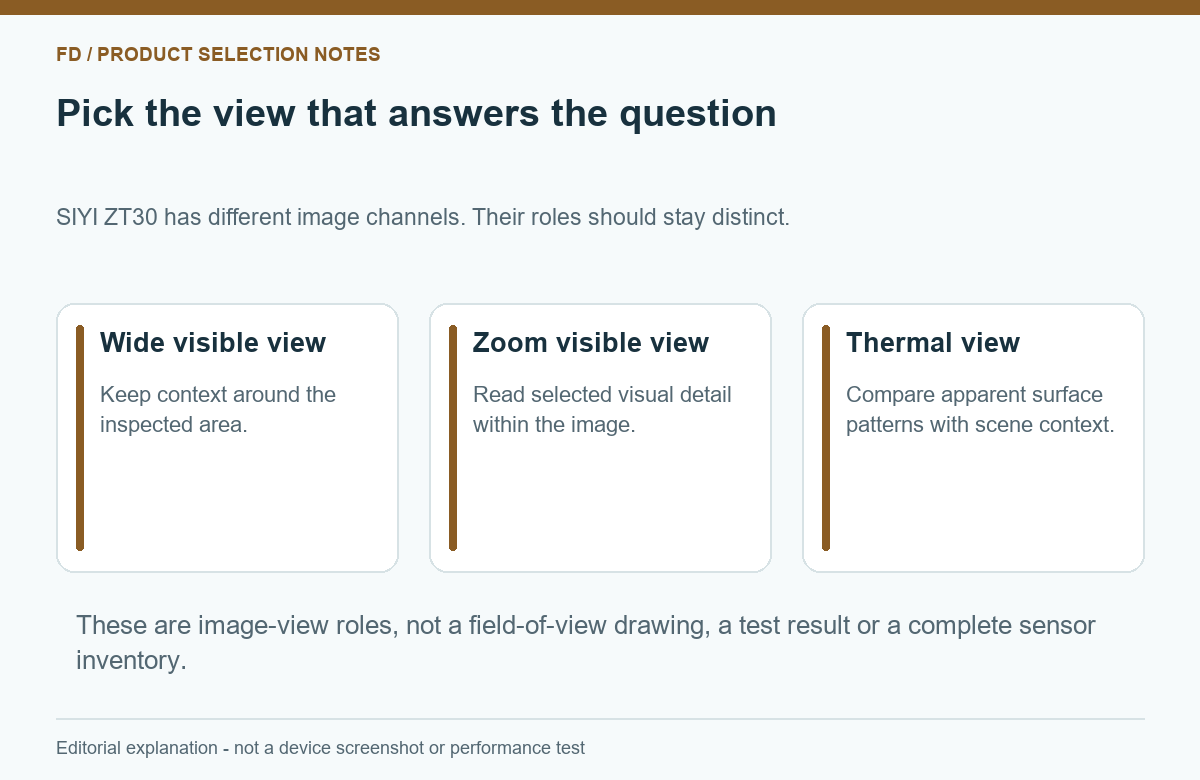
Use the SIYI ZT30 wide-angle camera to understand the setting, its optical zoom camera to examine visible detail, and its thermal camera to compare heat patterns. These views answer different questions; the most colorful or most magnified picture is not automatically the most useful one. ZT30 combines an independent 2K wide view, 30x optical visible zoom and native 640 × 512 thermal imaging with a 19 mm lens. Select it when a civil UAV inspection genuinely benefits from those complementary channels. Start by identifying the observation required, then decide which image belongs on the main screen and which file the customer needs afterward.
What surrounds this part of the building or equipment? Use recognizable shapes and spatial context to understand the scene.
What does the surface or small feature look like? Inspect visible appearance when the wider image leaves it too small.
Does this area show a different thermal pattern from its surroundings? Assess the observation in its material and environmental context.
One channel does not validate every conclusion suggested by another. A dark patch in the visible view might be staining, shadow or damage. A bright region in a thermal palette might reflect a temperature difference, a material property or a reflected heat source. Together the views can make an observation easier to interpret, but the sensor combination does not establish its cause automatically.
This distinction is useful before purchase. If the customer's deliverable is only a general visible-light video, three channels may add little value. If the customer must associate a thermal pattern with a recognizable component, the additional visible context has a clearer purpose.
The official ZT30 specification lists the wide-angle channel independently from the zoom camera. Its horizontal field of view is 84.5°, and its published local recording setting is 2560 × 1440 at 30 fps. This is a useful context camera, not a claim that every ZT30 image is 4K. A supplier should identify which camera generated a sample rather than labelling a mixed collection simply “ZT30 footage.”
For a roof inspection, the wide frame can show the relationship between a panel, a roof edge and nearby equipment. That relationship helps a person reviewing images later understand where a closer view belongs. The same benefit can apply to a facility exterior or a construction-progress review. It is contextual imaging, not a substitute for a positioning survey or a certified dimensional measurement.
At selection time, look at a full original frame on the screen that will actually be used. Determine whether the visible features remain easy to recognize at normal display size. A wide view that looks attractive on a large sales monitor might leave important context too small on a compact controller.
ZT30's zoom channel offers 30x optical magnification. SIYI also advertises 180x hybrid zoom, which is a separate figure involving electronic processing. A request for a “180x optical camera” would therefore describe the product incorrectly. When comparing samples, ask for the optical setting and the original image, rather than judging an enlarged browser preview.
The zoom camera can make a visible feature occupy a larger part of the frame. In a civil inspection, that may help a reviewer examine surface condition, recognizable labels or connections. Whether the information is sufficient depends on the feature and the viewing conditions. The product's magnification ratio cannot establish a universal reading distance for every sign or component.
The current specification gives the visible zoom camera a 3840 × 2160 at 30 fps local recording option. That is a channel-specific saved-file specification. It is not the thermal sensor resolution, and it does not guarantee that the ground station will receive the same resolution. Keeping those three meanings separate prevents an apparently detailed quotation from promising the wrong picture.
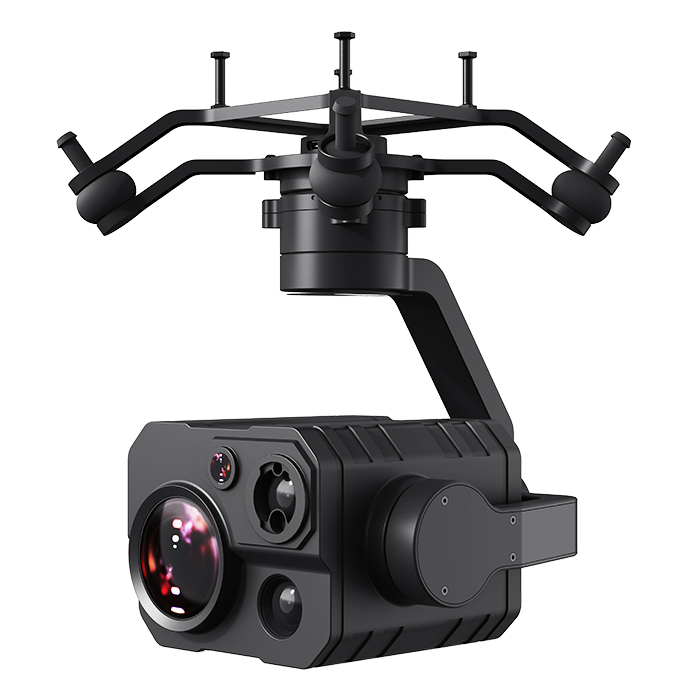
The thermal channel has a native 640 × 512 detector and a 19 mm lens. Its 2x digital zoom is electronic enlargement, not an increase in native sensing elements. Thermal imaging is valuable when the relevant observation involves heat patterns rather than visible color or texture. It does not turn the visible zoom camera into a thermal zoom lens.
Consider an inspection of accessible building equipment. The thermal image may reveal a region that differs from nearby regions, while the visible image helps identify the component and its surface. A qualified reviewer still needs the circumstances: material, loading, reflections and the conditions under which the image was captured. A temperature color palette is not a diagnosis of an electrical or structural fault.
ZT30 lists temperature measurement modes and different high- and low-gain ranges. If measurement is part of the purchase, request the applicable mode, range and accuracy conditions. Do not reduce those entries to one unconditional accuracy figure. For an application that only needs qualitative thermal comparison, avoid paying for a supposed analysis workflow that the receiving software or delivered files cannot support.
Three cameras do not require three permanently tiny windows. A picture-in-picture layout can preserve context, but the smaller window may be unsuitable for judging a fine surface detail or a subtle thermal pattern. Decide which view deserves the available screen area for the current observation. Treat any example arrangement in this article as an editorial concept, not a claim that every application exposes the same display controls.
For a compact display, ask the supplier to show the intended viewing application with a representative scene. Check the size of labels, the channel identifier and the thermal scale when one is displayed. A screenshot without a visible scale or image identity can be difficult to interpret after it has been separated from the original viewing session.
Also consider the reviewer who receives the files. A person may need the wide scene first, then a detail view, then the related thermal observation. This sequence can be clearer than one crowded collage. Do not assume a visual overlay means the sensor images have identical viewpoints, framing or pixel alignment.
| Required result | What to request | What the label alone cannot prove |
|---|---|---|
| Scene context | An original wide-camera file with its camera identity | That a mixed-view screenshot preserves the same framing |
| Visible detail | A zoom-camera original with its optical setting | That hybrid magnification adds equivalent optical detail |
| Thermal pattern | A thermal example with the visible scale and stated conditions | That displayed colors establish a particular fault |
| Temperature-data work | A representative file opened in the intended analysis software | That an ordinary exported picture carries usable measurement data |
| Live operator view | The actual Ethernet video chain on the intended display | That the local recording specification describes the received stream |
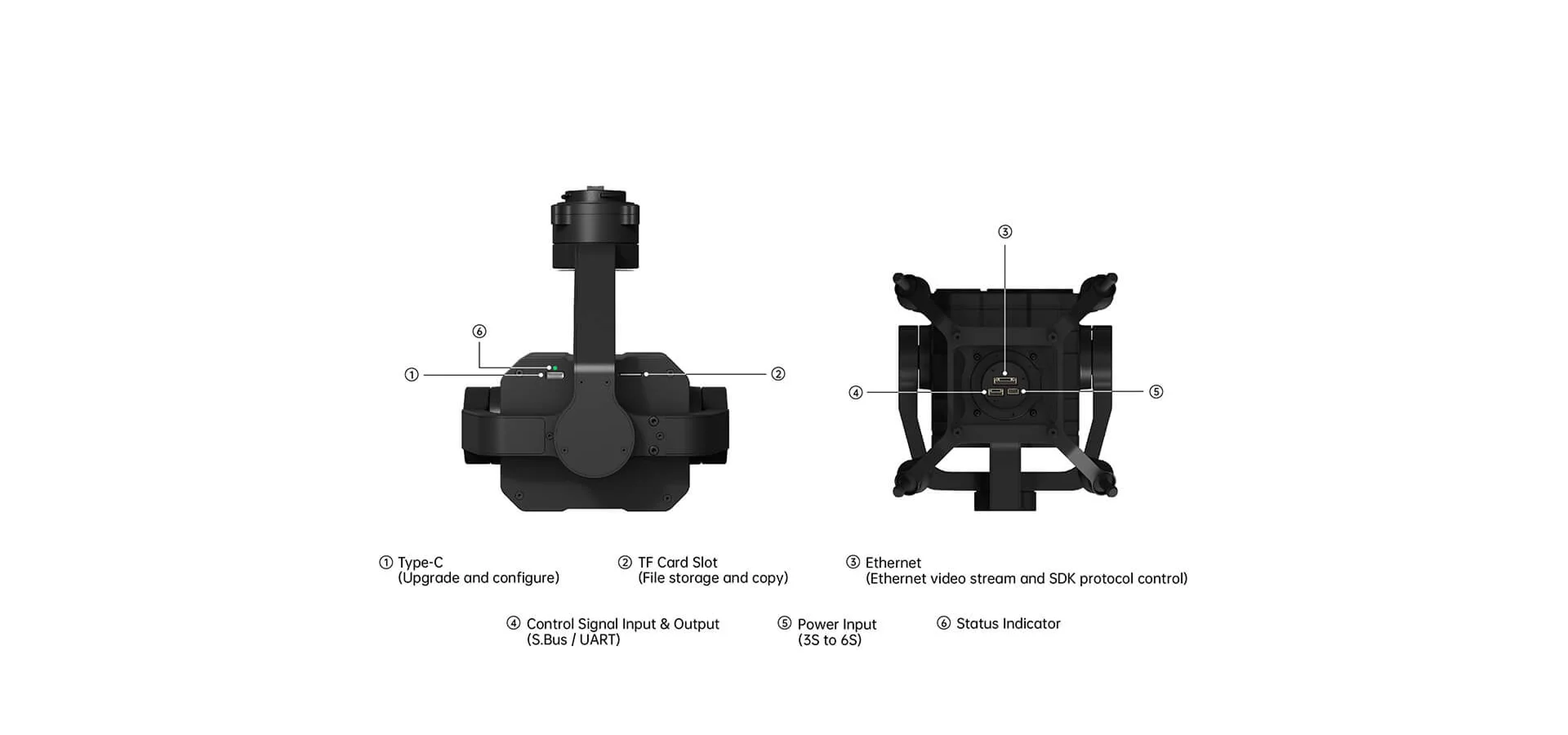
The current native output entry is Ethernet. Do not copy a Micro-HDMI feature from a different SIYI model into this quotation. Any additional converter, air unit or receiving device is part of the proposed system and needs its own connection check. The important issue is a usable picture at the required endpoint, rather than a collection of individually plausible connector names.
A facility inspection that must associate thermal observations with identifiable equipment is a reasonable ZT30 use case. The wide camera supports scene recognition, the zoom camera supplies visible detail and the thermal view supplies different contrast. This is an editorial application example; it does not claim that FD has tested a particular building, aircraft or diagnosis workflow.
A project that only needs visible progress video has a simpler requirement. It should compare an appropriate visible-only camera before choosing the larger multisensor package. Conversely, a job requiring dependable temperature analysis should evaluate actual thermal files and software, rather than assuming a three-camera payload automatically satisfies the reporting standard.
To discuss the appropriate channel combination, review the SIYI ZT30 configuration and request relevant sample files. Describe the observation, the intended aircraft and the screen or software that must use the images. Those details are more helpful than requesting the maximum number of sensors without a defined task.
No. Its native thermal array is 640 × 512. The 4K recording entry belongs to the visible zoom camera. Keeping the channel name beside the resolution avoids a misleading specification.
An image shows the radiation reaching the camera from the viewed surfaces and surroundings. A thermal pattern on a roof is not a direct picture through the roof. Any interpretation of conditions behind a surface needs other evidence and appropriate expertise.
Not necessarily. Small windows reduce the space available for detail. Evaluate the actual application and choose the main view according to the observation, rather than assuming more simultaneous windows produce more useful information.
No. Additional modules and software functions must match the offered configuration. This article does not depend on optional recognition functions; the purchase decision is based on the three imaging channels and their outputs.
Do not assume so. Ask for a real file and open it in the intended application before making that a purchasing requirement. A rendered thermal image and a temperature-data file can serve different purposes.
Source basis: SIYI ZT30 official technical specifications and User Manual v1.3, plus the FD product listing, checked 20 October 2026. Channel-selection examples and the explanatory diagram are editorial guidance; no field diagnosis, temperature accuracy test or software compatibility test is claimed.


 Tel: +86-13959965075
 Email: info@fpvdroneskit.com
 MP/WhatsApp: +86-13959965075
 Manufacturer Address:Quanzhou Valley Nanan Science and Technology Innovation Center, No. 89 Shijing Avenue, Shijing Town, Nanan City, Fujian Province